




































This story originally appeared on The Advocate.
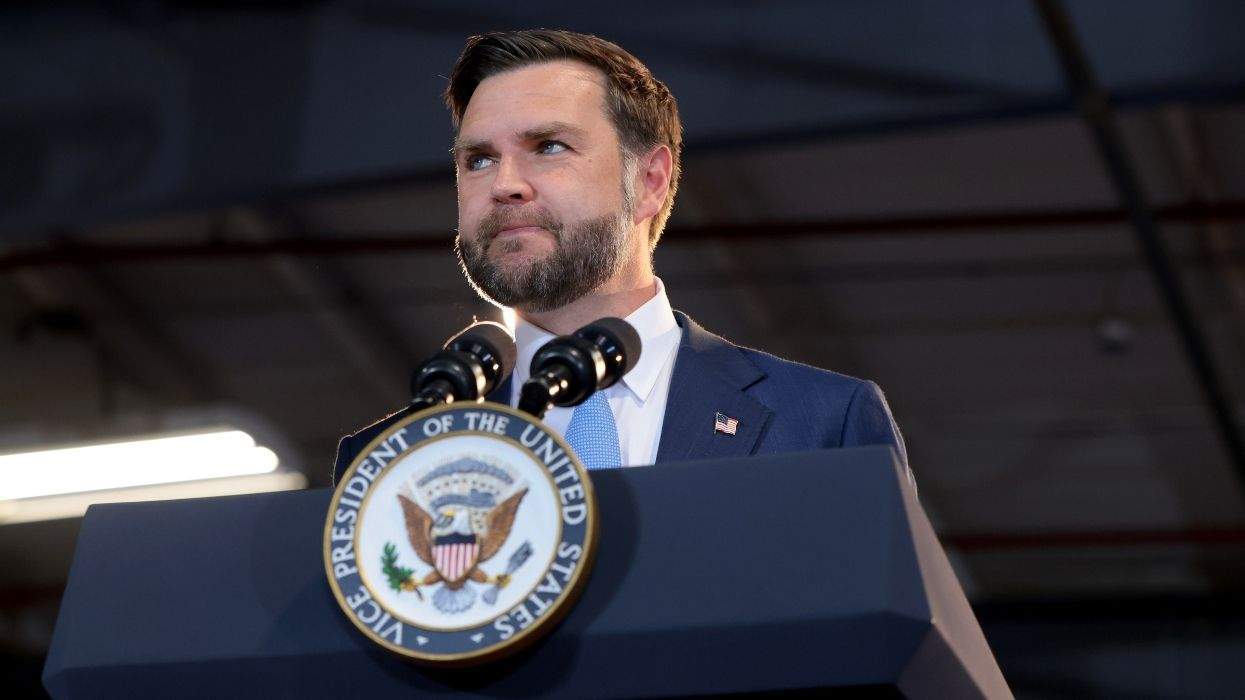
Vice President JD Vance arrived at a Maine defense contractor plant Monday to sell the Trump administration’s vision for American manufacturing. He began by commenting on another man’s face.
“Now, they didn’t tell me that Jamie was a good-looking guy with a beard,” Vance said while recognizing Jamie Beers, a maintenance manager at Compotech in Brewer. “Jamie, I hate good-looking guys with beards because they make me feel jealous.”
The bearded vice president quickly moved from Beers’ appearance to his life story.
“But I gotta say, Jamie is an amazing human being,” Vance continued. “He’s a maintenance manager here who worked his way through high school to learn his trade so he could take care of his three daughters.”
It was a throwaway joke. But it fit neatly within an administration that has made male bodies — their weight, hormones, hair and physical power — a recurring subject of politics and policy.
Vance’s own appearance has changed alongside his politics. He was heavier and clean-shaven when he became famous in 2016 as the author of Hillbilly Elegy and a prominent Republican critic of Donald Trump. By the time he ran for Senate in 2022, Vance had become one of Trump’s most aggressive defenders and had grown the full beard he still wears.
One of Vance’s former Yale Law School friends told the Washington Post in 2024 that the new look projected “a kind of severe masculinism.” A master barber interviewed by the newspaper called it a “maturity beard” and noted that facial hair can define and reshape a man’s face much like contouring makeup.
Vance also said in 2024 that he had lost 30 pounds in two years. He attributed the loss to running, gym workouts and eating less after he found himself winded while playing with his children.
The beard remained nonnegotiable even after Defense Secretary Pete Hegseth began imposing stricter grooming standards on the military. When Hegseth declared there would be “no more beardos” in the ranks, Vance endorsed the policy while exempting himself.
“When I was a young United States Marine, I did not have a beard,” Vance told reporters in October. “I am now the vice president, so I get to do what I want to do.”
The Advocate has reported extensively on the administration’s broader fixation with the male body. Hegseth recently launched a military-wide testosterone screening initiative promoted as part of a “High-T Department of War.” Service members age 30 and older must undergo annual testing, while those diagnosed with deficiencies may receive testosterone replacement therapy.
The administration has promoted hormones for presumed cisgender troops as an investment in strength, longevity and combat readiness while removing transgender service members and restricting their access to gender-affirming hormone care.
“This, by the way, is gender-affirming care,” Democratic Rep. Pramila Jayapal of Washington said when Hegseth announced the program.
Vermont Democratic Rep. Becca Balint offered a more political diagnosis. She told The Advocate in July that some administration officials display “weird, intense, homoerotic feelings towards men” while advancing anti-LGBTQ+ policies. Balint compared Hegseth’s cultivated “rugged macho man” persona to the exaggeratedly masculine figures drawn by gay erotic artist Tom of Finland.
Vance’s speech Monday eventually turned to manufacturing, trade and Maine’s November elections. He promoted former Maine Gov. Paul LePage’s congressional campaign, praised Republican Sen. Susan Collins and defended the administration’s trade war with Canada, which he said was a “state” before attributing the utterance to a “Freudian slip.”