
































The following Dolly Parton interviewed originally appeared in the July 1997 issue of Out magazine.
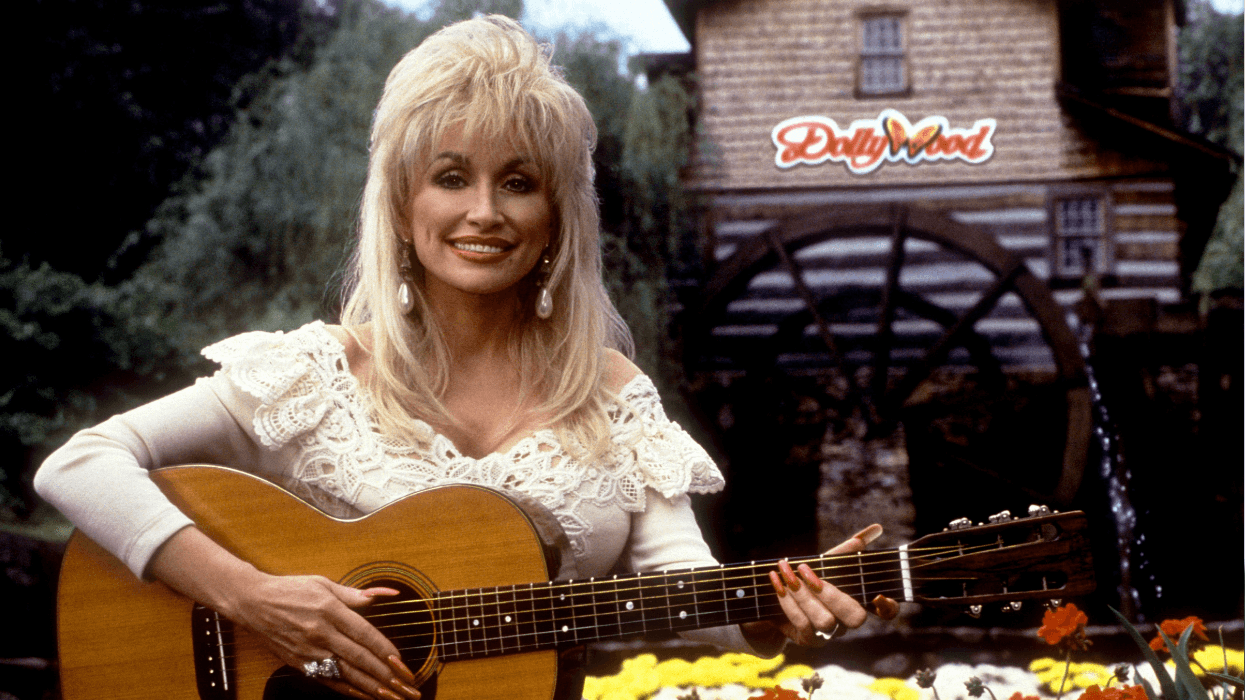
Dolly Parton is ready for dinner. All five-foot-one of her bodacious curves and Dynel blondness is perched on Frederick's of Hollywood-style mules as she moves through the lobby of the posh Pierre hotel overlooking New York's Central Park. Hers is a Southern manner both gracious and "oh my gracious."
Patsy Cline in Jessica Rabbit's body, she offers a friendly hello to anyone who cranes his neck to glimpse her-which is everyone. As she descends the stairs and settles into a corner banquette in the hotel cafe, the waiters stand in awe, each wearing a grin that says, It's so nice to have you back where you belong. One thing is certain: She is looking swell, this Dolly. A triumph of style over fashion in "an Azzedine shirt and a K Mart skirt," she is a star and then some. An icon, I call her. "An icon or an eyesore?" Parton shoots back.
This is definitely going to be fun.
"I can't even begin to imagine dressing up in a nice business suit and coming down to dinner," she says, after ordering seared foie gras and mashed potatoes. "I would much rather have the shock value of walking down the steps with my tits hanging out but knowing that I've still got the same brain and the same talent. What kind of fun would I have doing it if I had to be ordinary?"
Over the past 40 years, Parton has made a career of being extraordinary. By her own larger-than-life design-"It costs a lot of money to look this cheap!"-this backwoods babe has reinvented herself as a devilish cartoon with an angel's voice, a slyly campy comedian who has penned some of pop's most enduring songs, and an entertainer whose fans include punk rockers and Bible-thumpers, cross-dressers and conservatives, Calvin Klein and your mother. As Parton's friend, humorist and social-critic-at-large Fran Lebowitz says, "Even people who hate each other love Dolly Parton."
Worth an estimated $100 million-the royalties from Whitney Houston's megahit version of Parton's "I Will Always Love You" weren't exactly chump change-she has been to Hollywood, built a Great Smoky Mountains theme park called Dollywood, survived more than a few savagings by supermarket tabloids, and conquered a weight problem brought on because, as she says, "I'm a true hog by nature." With her classic country songs ("Jolene," "Coat of Many Colors"), her movie appearances (Best Little Whorehouse in Texas, Steel Magnolias), and her TV specials, she has garnered four Grammys, seven Country Music Association Awards, and even an Oscar nomination (for the title song to 9 to 5).
Parton's rags-to-riches story has always had particular resonance for gay and lesbian fans. After all, she was RuPaul before RuPaul was born, a paragon of self-reinvention outlined in lip-liner and raised to the heavens by an industrial-strength push-up bra. Born dirt poor and raised on a farm in Sevier County, Tennessee, Parton came from "a family of dreamers"—people with musical ability and a great sense of humor. But no matter how musical, they weren't exactly ready for a daughter as colorful as Dolly. "I used to fight with my daddy and my mama about the stuff I wore," she says. "I wasn't doing it to be trashy. I was doing it 'cause I didn't feel right just being ordinary. It was almost like being gay. It's a good thing I was born a woman, 'cause I'da damn sure been a drag queen if I hadn't. I can't get flamboyant enough."
Young Dolly found her soon-to-be signature look on a trip into town when she spotted a woman with "yellow blond hair all done up and bright red nails and high heels and this real tight skirt. I was a child, and I thought she was beautiful. Someone said, 'Oh, she's just a tramp.' And I thought, That's what I'm going to be when I grow up. So I patterned myself after the town tramp. I still have that look, and I still love it." As many of us struggle to do, the grown-up Parton merges citified sophistication with the human decency that comes from having the humblest of backgrounds. As Lebowitz says, "She would have been a star in any era."
Now, at 51, the singer, songwriter, author, actress, businesswoman, and theme park operator is reaching out to a new audience-circuit queens and club kids. She's doing it with a house version of "Peace Train," her cover of the 1971 Cat Stevens song. Remixed by DJ Junior Vasquez, among others, and featuring backup by the South African a cappella group Ladysmith Black Mambazo, the track originally came from her 1996 album, Treasures (Rising Tide). Released to disappointing sales, the eclectic, all-covers CD included Parton's versions of various country tunes plus Neil Young's ''After the Gold Rush" and Katrina the Waves' 1980s hit "Walking on Sunshine" (the song scheduled to be her second dance remix, due out later this year).
"I was looking for something to do that might be accepted in the 'new country' field," Parton says. "I'd tried a few other things that hadn't worked, and I thought, Well, maybe this'll work, and I did Treasures, and sure enough, that didn't work either." She laughs, then turns serious. "It's very hard anymore for some of us older artists to know what to do. You really can't sell yourself completely out and do something that's really not you, if you've always been trying to do quality stuff."
This is not Parton's first time at the disco—her 1978 "Baby, I'm Burnin"' and 1979's "Great Balls of Fire" were dance-oriented too—but Dolly as a full-fledged house diva is a new concept, courtesy of Kyle Utley, president of Flip-It Records, which is releasing the remixes. He thought Treasures was "brilliantly produced" (by Steve Buckingham) and that "Peace Train" was a natural for the dance floor. "Dolly sang her ass off on that album," says Utley. "I knew that if this woman would do a house track, the reaction would be volcanic." Judging from initial reaction in clubs like Arena, the New York hot spot where Vasquez spins, Utley is convinced it'll be a "monster hit."Parton is pleased by Utley's enthusiasm, but her predictions are more reserved. "They think they can sell it," she says. "I'm always tickled to be in any new place they put me." Those new places include an interview on RuPaul's radio show on New York's disco station WKTU—RuPaul is beautiful," Parton says—and her picture on the cover of Out.
These are unusual gigs for someone whose core audience includes members of the religious Right. In fact, at risk of reaching perhaps too wide an audience with her gay-friendly image, some of Parton's Southern "businesspeople" advised her to turn down RuPaul's VHl show. But Parton has no fear of potential repercussions from her conservative fans. "They could probably pitch a fit, but what am I supposed to do? This is what I do for a living," she says. "Gay people are fans of mine. It's two different worlds, and I live in both and I love them both, and I understand and accept both."
Parton has always been good at building bridges. When she first made the crossover to pop—with hits like "Here You Come Again" in 1977 and "9 to 5" in 1980—she said, 'I'm not leaving country, I'm just taking it with me." And in her private life, some of her closest friends are light-years from Nashville. Parton's best buddy since the early 1970s is her manager, Sandy Callin, the openly gay super-power broker who has advised Michael Jackson, Cher, Whoopi Goldberg, and Barbra Streisand, among others, and whose intimates include David Geffen and other members of Hollywood's so-called Velvet Mafia. "He's everything you would think that I wouldn't be compatible with," Parton says, "but Sandy and I fell in love instantly. He's the only person who ever saw my dreams the way I see them and believed it when I said I was going to be a big star." For his part, Callin calls Parton his "soul mate" and says the two are "as close as two people can be who aren't having sex."
"Parton's friendship with writer Lebowitz, the curmudgeon's curmudgeon, isn't exactly expected either. "Now you talk about an off-the-wall person and an unlikely friend of mine. She is such a hoot," Parton says. The twosome's nights out in New York's bohemian East Village—the inspiration for one awestruck lesbian short film—are legendary among the city's dykes.
Fueled by such allegiances, rumors that she's gay have surrounded Parton for years. "Everything that could be said about anyone has been said about Dolly," Callin says. Parton is glad to talk about the rumors and anything else. "That's half the fun for magazines like this," she says. "I don't care what you ask me. And if it's the truth, I'll tell you that, too." Some of her gay fans—and probably some of her detractors—cling to the belief that there's a bull dyke with a crew cut under all that gussy. At the very least, they want to know what the deal is with her constant companion, Judy Ogle. Parton wrote about their friendship in her 1994 autobiography, Dolly: My Life and Other Unfinished Business, and makes no secret of the fact that she's sharing a suite upstairs with Ogle the night we meet at the Pierre. But in divulging everything, Parton can leave you more confused than you were when you started.
"We've been best friends since we were in the third grade," she says. "A lot of people have tried to link us, but I'm not the least bit gay. Like I say, I'm not gay but my girlfriend is. That's like something I saw on a shirt. But anyway, Judy's just an old maid. People think because she never married that she must be a lesbian, and that because we've been together, that we must be lovers. But the fact is, I think Judy would rather be called a lesbian than an old maid.... She's had boyfriends over the years. She just never met anybody she loved enough to leave what she loved doing. But we're not lovers. If l was gay, I'd certainly never find a finer person than Judy as a mate. I'm as close to her just about as I am with my husband."
Parton has been married to Carl Dean for 33 years. Although rumormongers say she never sees her husband, Parton says she's with him more than ever, now that she's not touring. "They don't see me see my husband because he hates being in the limelight. But I see him all the time," she says. The secret to their marriage? "We just make a point to enjoy the stuff we enjoy together and stay out of each other's faces. I don't get in his shit, and he don't get in mine. And we get along great."
So does she have short black hair under her wig, as some have suggested? "Oh, I do not. I keep it bleached, and it's the same length that I keep my wigs. I don't always wear a wig. I do when I'm working because I can't stand to sit under a hair dryer or wait around with people pulling on my head. A lot of my early star days, I wasn't wearing wigs. We teased that hair up there and bleached it till it was just like a haystack." But nowadays, she says, "It's like one of my favorite jokes: How long does it take to do your hair? I say, 'Hell, I never know. I'm never there!"'
Parton has always been able to toss off a good zinger. While she may not call herself a feminist, she has used her cartoonish femininity to her advantage."Being a woman always served me well. Somebody said, 'Well, you know, it's always going to be a man's world.' I said, 'Well, you know what? I don't mind that it's a man's world, as long as they don't mind if we run it!"' Parton even stood up to The King. Elvis Presley wanted to record "I Will Always Love You" which Parton wrote in 1972 as a heartfelt adieu to her longtime singing partner, Porter Wagoner. Parton was thrilled with the prospect until she was told that as part of the deal Presley wanted half the publishing rights. "I said, 'Well, in that case, I don't guess Elvis is going to be recording "I Will Always Love You."' Everybody said, 'You've got to be out of your damn mind,"' Parton remembers. But she prevailed. She always has.
Still, no matter how rich or how successful she has become, Parton never shuns her fans. "It isn't that she's nice for a star, she's nice for anyone," says Fran Lebowitz. "Dolly talks to everyone who talks to her. If you're out to dinner with her, it ends up where you have the waiter sitting at the table." At the Pierre, the waiter hovers over Parton's table without ever pulling up a chair. But he would be as welcome as the crème brûlée put down before the guest of honor. "We're all exactly the same," Parton says, savoring the sweetness of her dessert. "Some of us just can express it better."


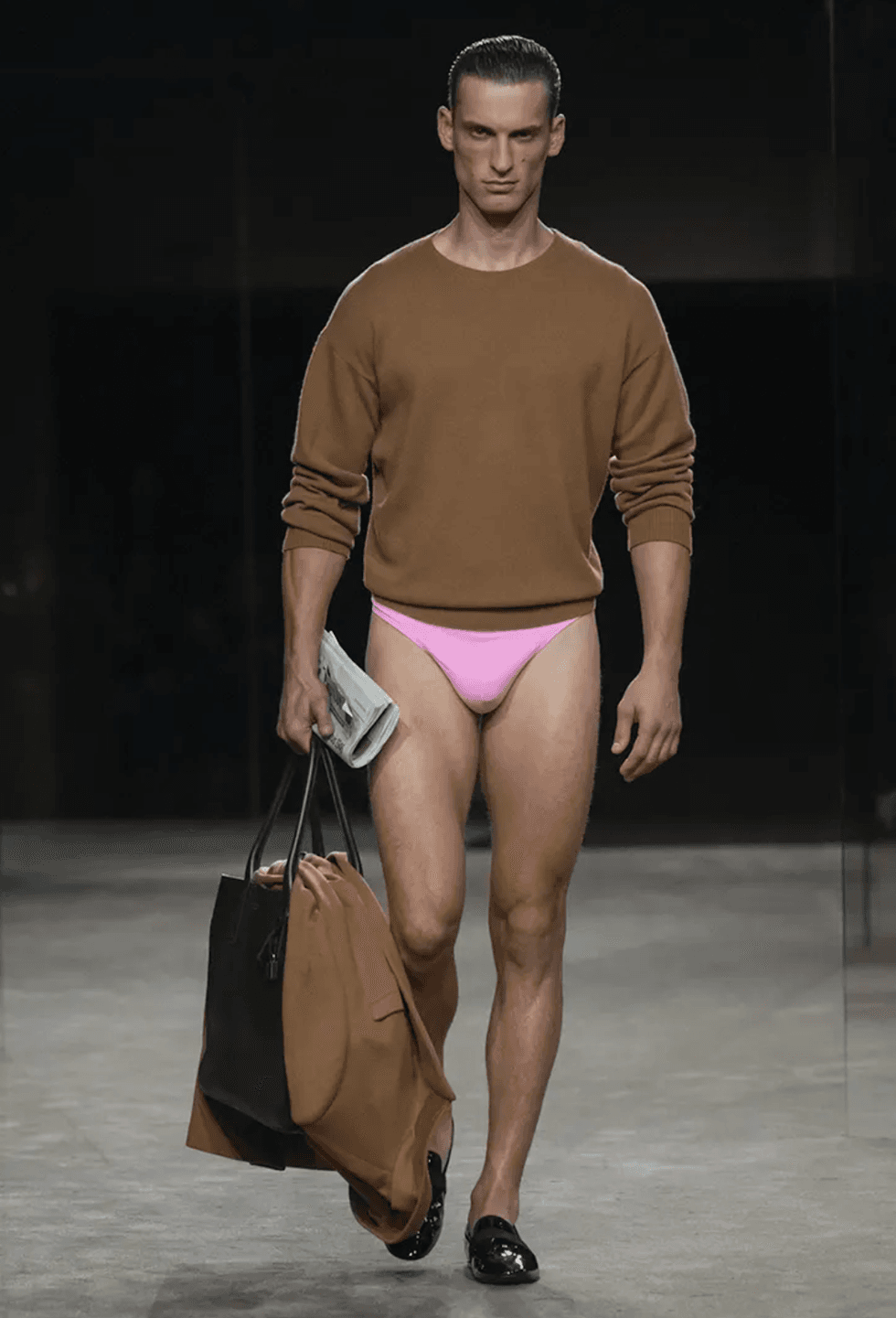 Tom Ford Model on runway at Paris Fashion Show Spring 2027Courtesy of Tom Ford