


























Warning: Mild spoilers for Blue Film to follow.
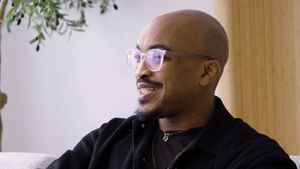
The term “blue movie” was used as slang to describe pornography during the mid-20th century. “But during the Hays Code,” director Elliot Tuttle tells me, “it was used to mark up film cells for anything that might not pass censors. Not just sexual stuff, but any kind of taboo or morally ambiguous thing.
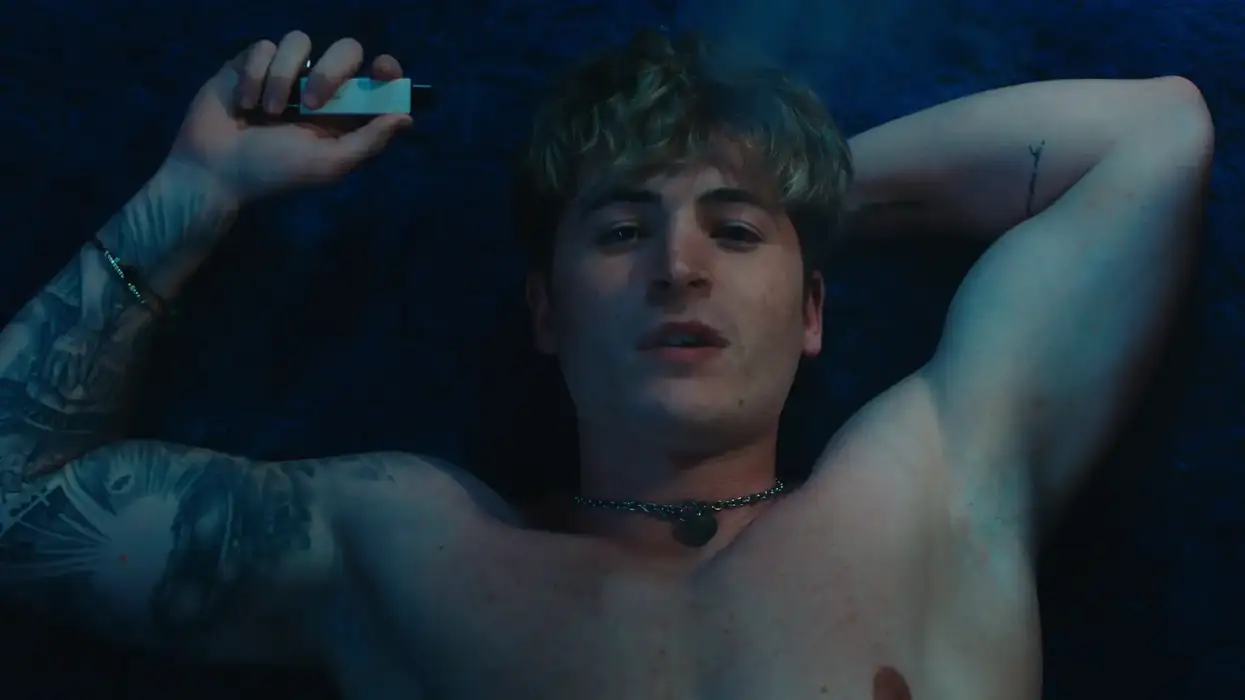
”It was this history that inspired the filmmaker’s debut feature Blue Film, a controversial exploration of taboo topics that one could easily imagine being censored. (In fact, in a way, it already has; multiple film festivals rejected it due to its racy content.) A chamber piece two-hander, Blue Film tells the story of Aaron (Boots’ Kieron Moore), a twentysomething gay cam sex worker who makes a living by degrading people on livestream, and the suspicious meeting he agrees to take with Hank (Reed Birney), an older john offering him $50,000 for the chance to spend one night with him.
But Hank isn’t interested in being dommed by this internet playboy. In fact, his interest in Aaron isn’t exactly sexual at all. (I’d suggest you stop reading now if you want to go into the film completely blind.) Hank, it turns out, is a pedophile, and Aaron, whose real name is Alex, is one of the pupils he used to teach in middle school before he was fired for the attempted assault of another student. Now, after finding meaning in religion, Hank has invited Aaron over to help him work through an existential identity crisis — namely, whether the love he once harbored for Aaron as a child can still exist now that the young boy he once knew is a hunky strapping man. Blue Film asks a thorny question: If Hank’s feelings can transcend age lines, how does that complicate his understanding of his disorder?
The film largely plays out through extended conversations, with the pair each finding new ways to open up to each other even as they dance around the disordered elephant in the room. It’s a boldly honest film, one that balances the sensitive insight of the Sundance award-winning documentary Pervert Park with the boundary-pushing work of directors like Catherine Breillat. As Hank and Aaron talk — brought to life through awards-worthy performances by Birney and Moore — they are forced to confront dark truths about themselves. For Hank, that means reckoning with what his disorder says about his relationship to God. And Aaron, who for years has clung onto an affected “dom” persona to help him feel powerful in a way he couldn’t otherwise, is finally afforded an opportunity to move past the trauma that turned him into an emotionally volatile shell of his former self some time ago. It’s the kind of movie we very rarely see today, both provocative in its central subject matter and defiant in its refusal to instruct the audience on how to feel. But underneath it all, this is also a deeply human story about loneliness.
A month before Blue Film’s limited theatrical release, Elliot Tuttle hopped on Zoom with Them to discuss his film’s long journey to cinemas, the joys of working with Reed Birney and Kieron Moore, and why Letterboxd is making him optimistic about the future of morally ambiguous cinema.
This is such a bold premise for your first film. How did you land on this particular idea?
I had this thing that I really wanted to make and I was just like, “I’m just going to do exactly what I want, because who knows if I’ll be able to make this kind of film in the future?” Hopefully I get money to do stuff in the future, but I felt like, “Well, I have this little amount of money. I have very little creative overhead. This is a really rare time where I can just do exactly what I want to do.
That’s kind of how it started, but it was borne out of a lot of things. It’s a personal story. It takes a lot from films that I love that I feel aren’t really being made anymore. Some [Catherine] Breillat or [Pier Paolo] Pasolini… We’re all just rewatching The Piano Teacher, but is any actual new Piano Teacher film being made? That was the guiding principle.
You just said that this was a “personal story.” Where do you see yourself in this script?
At the time, I had been journaling a lot about myself when I was 12 or 13. I was thinking a lot about adolescent sexuality and how very few films are honest about [it]. So it started from a place of thinking about my life retroactively, as an adult now with a lot of experience. I was thinking about how so much has [changed] about the way that I thought about sex at that time, when I was first becoming cognizant of what it meant.
I found a very personal arc in the character of Aaron about how I feel as a gay adult operating in the Los Angeles gay culture. So in that way, it felt very personal. But I also love to get conceptual in my writing, so the Hank character really stemmed from writings that I had done about sex that were just on my computer. It was more a discursive exploration of years’ worth of thoughts and ideas about sex, and how it affects the way that you live your life.
This film very comfortably exists in a gray area, but was there any effort to wrestle with how we feel about the morality of pedophilia — not in terms of the actions, but in terms of people with the disorder? Is there a world in which Hank should be thought of as a sympathetic character?
It’s a very fair question, but I would assume that we’re all walking into a theater with an understanding that the act of pedophilia is immoral and wrong. It can be kind of frustrating to explain that my film — or any film — is not an endorsement of behavior. At the heart of it, it’s a character study. One of the characters is a gay man, the other is a pedophile with a disordered sexuality, and it’s about meeting these characters where they’re at, and then engaging with the film in what it has to say or reckoning with how it makes you feel.
I’ve been to so many screenings where people walk out and have such varied reactions to the character of Hank, whether they found him sympathetic or found him really disgusting and just wielding the sympathy to some manipulative end. But my job as the filmmaker isn’t to be too prescriptive, because no film has to exist. Films don’t begin as material. They’re cultivated over a long period of time. They’re personal expressions and they change over time. A film can only meet you where you are willing to meet it. A film can be a personal reaction to a personal sentiment. It’s never an endorsement of behavior and it’s not that political to me. That’s not how I engage with films.
If you strip away the surrounding context, this ultimately is a story about two profoundly lonely people who are trying to find a common understanding by rehashing this past history they share.
Yes. And it was borne out of a kind of lonely time in my life. Also, the film, in its conception and how I intended to make it, was a drama. I wanted to make a compelling chamber piece that stood on its own merits as a piece of storytelling. That’s what I set out to do.
This is an interesting political climate for a movie that deals with pedophilia in such a frank way. For one, there’s been a rising conservative tendency to conflate queerness (especially as it relates to gay men) with pedophilia, despite being two very different things. But secondly, discussions of pedophilia are everywhere now that the Epstein files have been released. Where do you think your film fits in within this current conversation around pedophilia?
As a filmmaker, I want to trust my audience, so part of me is completely disinterested in the sect of people who conflate gay men with pedophiles. I’m not making a film for those people. I would never want to be so reductive with my storytelling to appease that crowd because it’s so silly. It’s such a sad, depressing idea to me that any artist would be held back by such juvenile and stupid thinking. It’s very prohibitive of any kind of creative process, and I wouldn’t want that to inform any of the art that I consume. If we don’t have nuance, then everything would be so, so boring, so it was very secondary to me in the process of making this film. Whether one thinks that’s reckless or not [is ultimately up to them], but I choose to make films for a smarter audience.
The casting for both Hank and Aaron is great, which is so important since this is, as you said, a two-person chamber piece. How did you settle on Kieron Moore and Reed Birney?
I wanted Reed in it from the very beginning. I think he’s such a talented, iconic actor. I loved him in Mass, which was this Sundance film, and I’m just so lucky that he agreed to do it. He was always my first choice, and he is just so, so smart. It’s like magic what he does.
Then, Kieron came out of a Zoom chemistry read. We were really blown away by him. He just changed the character. It’s so cool when you see an actor take your words and then create something that you had never conceived of. He just brought this really brutish physicality to the part. He brought this hulking dominance that really spoke to the reference point of these findom cam-boys who are just sitting in gross bedrooms, berating you for money.
Working with them was such a dream. Both were so willing to engage with the material. They were so eager and excited to play the parts. It’s such a great gift to find two people who really care.
You submitted Blue Film to at least 10 different film festivals and were rejected by all of them, including notable ones such as Sundance. Earlier, you mentioned that you knew your film would be a tough sell. Were you prepared for the rejections, or did any of them come as a surprise?
It was both. We knew from the very beginning that it would be a tough sell, but after we finished post-production, we really believed in the quality of the film. I mean, before production, you can believe in the quality of the script and of the people who you cast, but until you’re done and in the editing suite and you’ve seen multiple cuts of the film, you can’t really believe in the quality of the film itself. But once we were all done, we were like, “We think this film is good, so maybe it’ll be an easier sell now. Maybe people will take it seriously.” So [the response] was deflating, but it was also galvanizing in a way.
A lot of people in my circle are consistently disappointed in programming and the festival landscape right now, and I think we’re all looking around at each other and being like, “Oh, it seems like it’s maybe on us to figure out how to reinvent the system in a way that works for filmmakers and audiences, and not corporate sponsors or whatever.” The goal is to connect a film with an audience, and now, the goal has become clouded by so many other things. I do feel like we’re almost reaching this point where a bubble is going to burst. But it was disappointing to see the film rejected.
Festival programmers are who I’d expect to be the last bastion of cinematic integrity. I could expect that response from certain audiences. I’ve noticed a very concerning modern-day tendency for some people to turn their head away from anything challenging or uncomfortable. There’s a wave of people who want movies to reflect perfect morality back at them. But it’s quite disheartening to hear that festival programmers are succumbing to a similar line of thought.
I mean, it is exhausting to have to read opinions by people who believe films to be some puritanical guide on how to live life and behave in a good way. For one, I feel like anyone programming with that ethos or making decisions with that ethos… it’s a total disrespect for the audience to not trust the audience at all to be able to engage critically with something.
I feel like media literacy is on the decline. But we can’t go down without a fight! We need to open the schools! We need to combat media illiteracy! And yeah, it is depressing to think that festivals wouldn’t be the last ones standing up for it. But also, [the festivals are] sponsored by Acura! [laughs] So I honestly think that the true last guard of people fighting to reclaim media literacy and protect morally ambiguous art are going to be filmmakers and audiences. I’m very optimistic about a swing back in the next couple years.
Is there anything that has happened recently that is making you feel optimistic?
Honestly, one thing that makes me feel really optimistic is Letterboxd. It’s just an app, but it’s become a “cool” thing to have, even if you don’t care that much about films. Now, watching films is a little bit cooler than it was before, so many more people are watching and engaging with movies, and that means a lot more smart people.
But I’ve really been impressed with films that have foregone a traditional model of appealing to “industry figureheads” or more “corporate interests.” I’m thinking about films like Hundreds of Beavers, or Betsey Brown’s Actors, or my friend Annapurna [Sriram], who made a film called Fucktoys. These are all films that are bridging their own gap to audiences and kind of insisting upon more community-oriented and intelligent engagement with the art. Whenever I see a film be successful in that way, it makes me really happy. I just saw The Drama with a full crowd, and even when I hear people laughing, that makes me feel happy because I’m like, “Oh, people are being normal in public spaces. Let’s go.” That’s awesome.
You’ve gone on a long, arduous journey with this film and it’s now finally coming out for people around the world to see in a theater. What do you hope audiences come away feeling after seeing Blue Film? What do you hope they engage with the most?
I do hope that audiences are moved by the film, because it was created to be a drama. I hope to see people crying or throwing up or laughing. I just want people to feel something about the film. I’d rather them feel something than nothing. And I hope that it sparks debate. I hope that people are arguing about their opinions about it after. That’s always my favorite filmgoing experience.
This interview has been edited and condensed for clarity.
Blue Film opens in limited theaters on May 8.
Get the best of what’s queer. Sign up for Them’s weekly newsletter here.