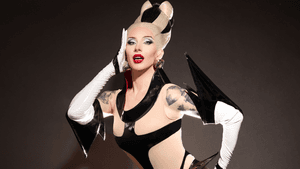
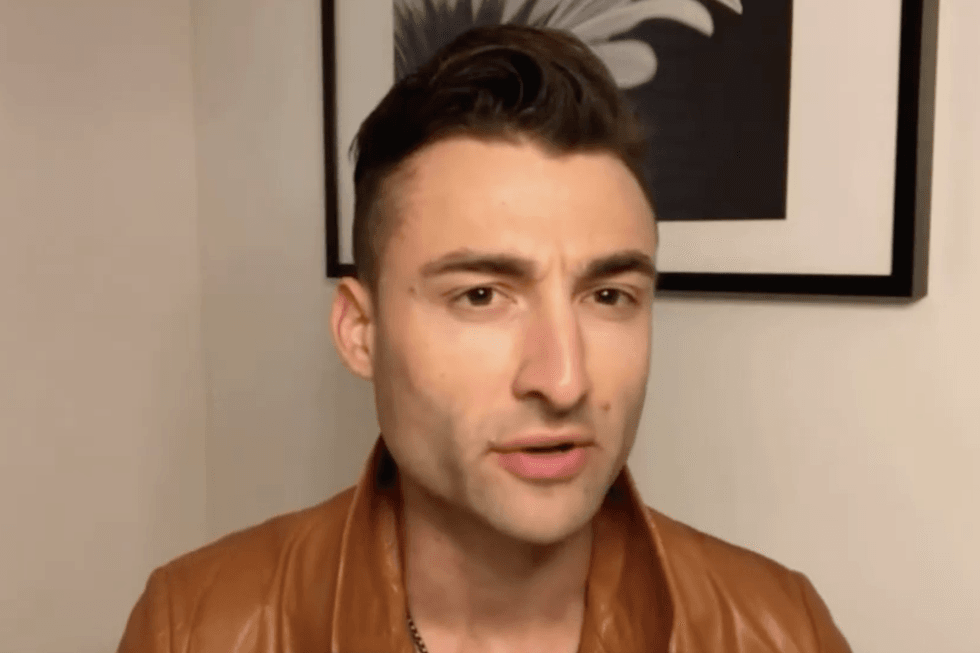
Vivian Jenna Wilson knows what's at stake for the LGBTQ+ community. With the fast-approaching midterms, the famous transgender model is using her platform to showcase her unapologetic queerness at a pivotal moment in history.
Wilson has teamed up with Desigual on their empowering new campaign, Born to Disobey, which encourages queer people to claim their freedom and question society's traditional rules. In the viral campaign photos, she even takes a stand against the rise of AI and technology by playfully mocking a robot.
"It was such a great time participating in this campaign. The title is very charming and somewhat of an oxymoron, but systems are not fought with campaigns. They are fought with protests, activists, and societal political movements demanding sweeping changes. The midterms are coming up and we are being employed as the scapegoat to make people forget about the economy, the Iran war, and the Epstein files," Wilson tells Out.
As LGBTQ+ equality remains a hot-button topic in today's hostile political climate, Wilson is reminding her queer peers to fight back and make their voices heard at the polls this November.
"The importance of queer people building community and support networks in this time cannot be understated. With the government attempting to ban gender affirming care for trans people through an already broken and corrupt healthcare system, the repealment of anti-discrimination laws, and the demonization of queer people, we need to be there for each other right now."
Wilson understands that the LGBTQ+ community has fought for basic rights for decades, but she argues now is not the time for complacency when a potential blue wave could spark crucial progress.
"Look forward to conservatives shouting incessantly about us like kids whose ball went over the fence. Unfortunately, because they are completely incompetent, they have decided to try and distract everyone with how ookity-spookity trans people are."
While the transgender model is proactively creating opportunities and safe spaces for her chosen family, Wilson also reminds everyone to lean on one another through every major milestone. She also hopes to see every queer person expressing themselves as freely as they'd like.
"Many of us, including myself, end up having most of our typical teenage experiences in early adulthood. I think there's a specific beauty in that. Fashion has helped me figure out who I am, and made me more confident in my aesthetic and how I'm facing the world. To be honest, the people I met in fashion have likely had more of an impact on me than fashion itself. You are not alone. Find queer community however you can will always be my advice. Just be careful, safety should always be your priority."
The Republican Party is full of politicians who actively fight to strip LGBTQ+ people of their rights and humanity. But it is often those same politicians who get caught up in gay sex scandals or have their sexualities whispered about on Capitol Hill, while proclaiming their heterosexuality and adherence to “traditional family values.”
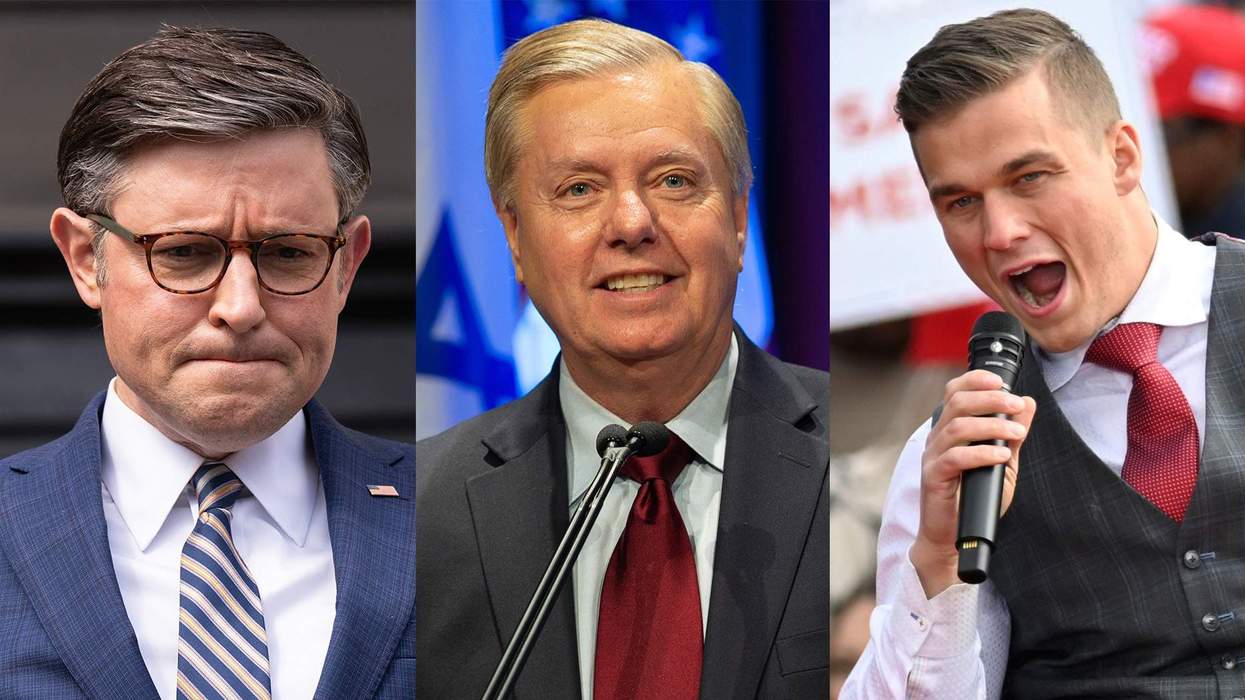
Rumors that conservatives like Lindsey Graham and Mike Johnson are secretly gay have spread for decades, while politicians like Larry Craig and Wes Goodman saw their careers implode after scandals involving other men came to light.
Often, the Republicans who are the most vocal in their opposition to the queer community and the loudest when spouting anti-LGBTQ+ rhetoric are the same ones who the public claims are closeted. From secretly doing drag to behaving in ways their fellow conservatives would describe as effeminate, their hatred hasn’t protected them from rumors spreading.
Washington’s closeted political culture is hardly new. James Kirchick’s 2022 book, Secret City: The Hidden History of Gay Washington, documents an underground world of predominantly white gay men who worked in and around presidential administrations from Franklin Roosevelt through Bill Clinton. As The Advocate reported, gay men were intensely policed, particularly by the FBI, and coming out could lead to arrest, dismissal, or the loss of a security clearance. Many officials’ sexualities were revealed only after their deaths.
That history grew even more complicated during the 1980s, when the rise of the Christian right and the AIDS crisis turned homosexuality into a potent Republican political weapon. Closeted gay men continued serving in conservative administrations even as the party increasingly defined itself through opposition to LGBTQ+ equality.
Regardless of their actual sexualities — most have denied the gay allegations — none of the stereotypes surrounding grooming, clothing, or gender expression prove that someone is gay. But if a politician is virulently anti-LGBTQ+, the whiff of hypocrisy guarantees the rumors will spread, and sometimes those politicians really do get caught with their pants down with another man.
Lindsey Graham
Lindsey Graham
lev radin/Shutterstock
When U.S. Sen. Lindsey Graham died in July, the South Carolina foreign policy hawk left behind three decades of opposition to LGBTQ+ civil rights advances, including years of declining to recognize same-sex marriage, supporting “Don’t Ask, Don’t Tell,” and voting against the Employment Non-Discrimination Act in 2013.
He also left behind years of speculation about his sexuality. Rumors that Graham was gay swirled around his lengthy political career up until the time of his death. Graham’s status as a lifelong bachelor who never married or had children led to years of insinuations that he was gay, often manifesting as homophobic jokes and attacks against him, despite his frequent denials.
This speculation intensified in June 2020 after gay adult film performer Sean Harding posted allegations involving an unnamed Republican senator that social media users linked to Graham, who was allegedly nicknamed “Lady G” by male sex workers who claimed him as a client. Harding did not publicly provide evidence substantiating the allegations.
Trump loyalist Laura Loomer testified in 2025 that Graham was gay and closeted, and insisted that his sexuality had been an open secret on Capitol Hill. After Graham’s death, author Jesse James Rose went viral after penning an Instagram post alleging the politician used to pay her to “do unspeakable things to him in a hotel room while he wore red lingerie” prior to her gender transition, when she was a “twinky pre-transition college student.” Rose’s account has not been independently corroborated.
Rose’s post prompted another transgender woman, Taylor Snider, to come forward. In a recent collaboration between Them and The Advocate, Snider alleged that Graham paid her for about half an hour of sex work at a Washington hotel on June 7, 2015 — six days after he launched his presidential campaign. Snider said she did not realize who her client was until she saw Graham on CNN about a week later.
Them reviewed screenshots of a dated advertisement and text exchange that appeared to arrange the appointment, although the outlet could not independently verify the messages. Snider said she came forward to “point out the hypocrisies that are actively in our world right now,” noting Graham’s later attacks on transgender rights. Graham also championed FOSTA-SESTA, legislation that further criminalized online sex work and that advocates say made sex workers more vulnerable to violence.
Ron DeSantis
Ron DeSantis
Andrew Cline/Shutterstock
Florida Gov. Ron DeSantis is responsible for the infamous “Don’t Say Gay” law, which banned public school teachers from providing classroom instruction about sexual orientation or gender identity, as well as restrictions on gender-affirming procedures for trans youth. His ultra-regressive views on the LGBTQ+ community haven’t protected the Florida Republican and Trump ally from rumors about his sexual orientation.
DeSantis has faced whispers about his sexuality for years that were made worse when he was photographed wearing what social media users claimed were hidden heels in his boots. The photos quickly went viral and inspired questions about his sexuality and claims that he’s a drag queen, which was a pointed criticism considering DeSantis’ fight to ban children from drag shows. Of course, wearing lifts — or being compared to a drag queen — is not evidence of someone’s sexuality.
Mike Johnson
Mike Johnson
lev radin/Shutterstock
Speaker of the House Mike Johnson’s homophobic and transphobic views can’t be overstated. He backed a measure barring transgender people from using bathrooms aligned with their gender identity in the U.S. Capitol; he has supported criminalizing gay sex, was an attorney for the far-right Alliance Defending Freedom, defended “gay conversion therapy” organizations like Exodus International; and the Human Rights Campaign dubbed him the “most anti-equality” speaker in U.S. history. Even Meghan McCain called the Trump ally a “raging homophobe.”
But his anti-LGBTQ+ beliefs and Johnson’s more than 25-year marriage to a woman, with whom he shares four children, haven’t stopped years of gay rumors from spreading about the vocal MAGA supporter.
The search term “Mike Johnson Grindr” started trending in 2025 when an anonymous man went viral on TikTok after making unsubstantiated claims that he had proof Johnson had a private Grindr profile and threatening to make it public unless the Trump administration released the Jeffrey Epstein files. No such evidence was produced. More rumors spread when Johnson admitted that he and his son monitor each other’s porn habits.
John Strand
Controversial figure John Strand isn’t shy about telling voters that he’s a Jan. 6 rioter who spent close to a year in federal prison before being pardoned by Trump, alongside about 1,500 other people convicted of Jan. 6-related offenses. What the Florida congressional candidate didn’t advertise was his past as a male underwear model living in West Hollywood.
Strand may be a vocal MAGA supporter, but in his youth he was a struggling model in West Hollywood, according to a Mother Jones exposé. People who knew him at the time told the publication that Strand attended a party at the historic gay bar The Abbey, got a job working in an Equinox booth at West Hollywood Pride, posed nearly nude for the cover of French gay magazine Sensitif, and “would go out with his boys” while his wife “would stay home.”
Madison Cawthorn
Madison Cawthorn
Peter Zay/Anadolu Agency via Getty Images
The rumors about his sexuality that have plagued former Republican U.S. Rep. Madison Cawthorn for years intensified in 2022 when Politico obtained photos of the embattled former North Carolina congressman wearing women’s lingerie at what looked like a party.
Just weeks after the photos came to light, Cawthorn became embroiled in another scandal; this time, a video clip was released showing the former rising star in the MAGA movement naked in bed with his male cousin. Cawthorn, who once accused his GOP colleagues of “sexual perversion”, denied that there was anything wrong with the video and said he was just “being crass with a friend” and acting “foolish.”
These scandals fueled rumors that he is secretly gay, despite his anti-LGBTQ+ political record, which includes opposing the Respect for Marriage Act, a law requiring state and federal governments to recognize same-sex marriages, and voting against the Equality Act, which would have banned anti-LGBTQ+ discrimination in employment and housing.
Josh Hawley
Josh Hawley
RadRadMedia/Shutterstock
Josh Hawley, a Republican senator from Missouri, once sent an email to his followers telling them that there are only two genders, said that businesses should legally be allowed to deny service to same-sex couples, asked “Can men get pregnant?” multiple times during a Senate abortion hearing in January, claimed that “almost half” of Netflix’s content promotes “transgender ideology,” and voted against the Respect for Marriage Act.
Despite all of this, Hawley has recently found himself at the center of rumors questioning his sexuality. Not only was Hawley one of the names Hunter Biden brought up when talking to journalist Don Lemon about the group of powerful closeted politicians he dubbed the “closetocracy,” but he was also the subject of a recent viral social media post accusing him of kissing a “male escort.”
Pro-LGBTQ+ chef and content creator Joe Gera claimed that Hawley paid off a busboy who spotted him kissing a male date behind a restaurant. Gera did not provide publicly verifiable evidence supporting the claim.
Matt Schlapp
Matt Schlapp
Mark Reinstein/Shutterstock
Matt Schlapp is the former White House director of political affairs under George W. Bush and a current Trump ally who has been accused of sexual assault multiple times, including by a male staffer and two other men. He is the head of the virulently anti-LGBTQ+ American Conservative Union, which organizes the Conservative Political Action Conference. Both ACU and CPAC promote anti-LGBTQ+ rhetoric, oppose same-sex marriage, and fight against transgender rights.
The so-called “family values” Republican was accused of sexually assaulting Carlton Huffman, a Republican staffer on Herschel Walker’s U.S. Senate campaign who was tasked with driving Schlapp in October 2022. The male staffer alleged that Schlapp groped his genitals without his consent and invited Huffman to come to his hotel room.
Huffman ultimately received a $480,000 settlement paid through an insurance policy on behalf of Schlapp and the ACU in exchange for dropping his sexual assault lawsuit. Schlapp continued to proclaim his innocence and said he had been exonerated.
Larry Craig
Larry Craig
Wikimedia Commons
A stalwart of the conservative wing of the Republican Party, former U.S. Sen. Larry Craig went from voting against gay rights to being caught up in a police sting in an airport men’s restroom. The former Idaho senator was arrested on June 11, 2007, during an undercover vice operation at Minneapolis-St. Paul International Airport.
Craig was one of 41 arrests made in the type of police entrapment operations that used to target gay men, involving an undercover officer signaling to a man in the stall next door and then waiting for him to respond in kind. These supposed covert foot movements were enough to get men busted on charges of lewd conduct.
Craig was arrested and quietly pleaded guilty to a misdemeanor charge of disorderly conduct, but claimed the whole thing was a misunderstanding and insisted he was not gay and was not seeking sex when he touched the police officer’s foot.
“I am not gay. I never have been gay,” he said at a news conference.
The anti-gay politician’s Republican allies dropped him like a hot potato as soon as news of the scandal broke. Republicans like Mitch McConnell, John McCain and Mitt Romney, along with religious conservative political adviser Pat Buchanan, all spoke out against him.
Craig announced that he would resign but later reversed his decision and served until his term expired in January 2009. His stunning downfall ended his political career, and he was later ordered to repay money and pay penalties for using campaign funds for his legal defense.
Conservative Christian lawmaker Wes Goodman’s up-and-coming Republican career was over the second he got caught living a double life and exchanging sexually suggestive emails with gay men. Goodman was a conservative “family values” Republican who championed “traditional family values” and anti-LGBTQ+ causes.
But Goodman ended up having to resign from the Ohio legislature in disgrace after he was caught in “inappropriate behavior” of a romantic or sexual nature with a man in his office, and salacious texts and emails he exchanged with gay men he met on Capitol Hill came to light.
Rumors that Goodman was a closeted gay man had been spreading for years before he got caught. Goodman aspired to run for Congress, but his right-wing political career ended in resignation when House Chief of Staff Mike Dittoe was informed about the incident, and House Speaker Cliff Rosenberger learned of the allegations.
“He acknowledged and confirmed the allegations,” Rosenberger said, according to reporting from The Advocate at the time.
Stephen Miller
Stephen Miller
lev radin/Shutterstock
Far-right senior Trump adviser Stephen Miller is vehemently anti-LGBTQ+. Not only is Miller the co-founder of America First Legal, which served as one of Project 2025’s advisory organizations and has openly attacked the rights of transgender students, but he also takes his hatred to bizarre ends, like attacking Pop-Tarts for corrupting children by partnering with GLAAD for Pride Month.
Miller’s open hatred for the LGBTQ+ community hasn’t stopped the rumor mill. People started joking that Miller was in a throuple and having three-way sex with his wife and Elon Musk in 2025 after Miller’s wife, Katie Miller, left the Trump administration to take a job with Musk’s artificial intelligence company, xAI.
During a conversation with I’ve Had It podcast host Jennifer Welch on his YouTube channel, journalist Don Lemon said, “I thought he was gay,” and that he got a “gaydar ping” from Miller. The MAGA loyalist was also one of the names Hunter Biden dropped when talking about the “closetocracy” he claims is running the government.
Unlike most of the men on this list, Transportation Secretary Sean Duffy’s son-in-law, Michael Alfonso, is new to politics and hasn’t dealt with years of gay rumors plaguing him. Alfonso just won the Republican primary in Wisconsin’s 7th Congressional District, but instead of focusing on the upcoming election against Democratic former state Rep. Fred Clark, he has been going viral lately because of his eyebrows.
Dubbed a “MAGA Warrior” by President Trump, who also endorsed him in January, the nepo-baby politician has been widely lambasted on social media for his prominent and well-groomed eyebrows. While some of the jokes lobbed at Alfonso have been about his resemblance to a certain Sesame Street character who is “best friends” with Ernie, many of them have also fed into rumors that his manscaping is proof that he is gay. It isn’t, but the jokes reveal how quickly conservatives’ rigid ideas about masculinity can be turned against them.
From the moment that Donald Trump was elected for the first time in 2016, his negative influence has been a constant shadow looming over the United States. He has stacked the U.S. Supreme Court with judges favorable to the conservative agenda, started a crusade to strip transgender people of their rights, and cut domestic and global HIV funding.
But while he was using his time in office to make decisions that make every Democrat's blood boil, he has also been consistently embarrassing himself at every turn.
Some of these moments are historically humiliating, some will leave you scratching your head, and others are downright hilarious. Check out Trump’s most embarrassing moments since he first took office back in 2016.
World Cup cold shoulder
Spain took home soccer’s biggest award when they beat Argentina at the 2026 World Cup, but their win was soured when Trump tried to jockey his way into their victory photos. Video footage of the historic moment shows several players trying to politely push Trump toward the edge of the dais so that he wouldn't be in their photos, and when Spain’s national football league shared an image of the team lifting the trophy over their heads, Trump had been cropped out of the shot.
Hair mishaps
Trump’s hair has provided fodder for comedians for years, and much has been written about the president’s coif. Trump’s hair usually seems frozen in place, but every once in a while the wind catches his comb-over just right and it lifts off his head. Back in 2018, Trump was mercilessly ridiculed when a strong wind swept his hair off of his head when he hit the tarmac at Andrews Air Force Base in Maryland. When Trump was on trial in April 2024, his hair also flapped off his head during an interview with reporters, and again on August 3, 2026, when it flew up and exposed a portion of his bald head as he disembarked from Marine One.
Falling asleep on the job
Trump has been accused of struggling to stay awake and dozing off during several high-profile events, but the most egregious instance may have been when New York Times journalist Maggie Haberman reported that Trump fell asleep during his own hush-money trial, the first criminal trial of a former or sitting president. According to Haberman, Trump “appeared to nod off a few times” during his court appearance when she saw “his mouth going slack and his head drooping onto his chest.” The president, who repeatedly referred to former President Joe Biden as “Sleepy Joe,” was called out for falling asleep at an inopportune time again on July 28, 2026, when he was filmed nodding off at Lindsey Graham’s funeral.
Bombing hurricanes
Trump reportedly suggested senior Homeland Security and national security officials consider using nuclear bombs to contain a severe weather crisis. During a hurricane briefing at the White House in 2019, Axios reported that Trump said, "I got it. I got it. Why don't we nuke them?" The publication also reported that a 2017 National Security Council memo stated that the president floated the idea that we should “bomb the hurricanes.” Trump called the allegations ”ridiculous” and claimed on social media that he “never said this.”
Being mocked by world leaders
A hot mic moment at a NATO summit in 2019 revealed that other world leaders had no qualms about openly mocking Trump. A video emerged during the summit showing Boris Johnson, Justin Trudeau, and Emmanuel Macron at a function at Buckingham Palace, where they gathered to make jokes that appeared to be about Trump. Johnson can be heard asking Macron, “Is that why he was late?” before Trudeau says, “He was late because he takes a 40-minute press conference off the top.” This exchange was interpreted as about the American president because Trump had done an unscripted 50-minute back-and-forth with reporters just days before, and done much the same thing at the previous year’s Nato meeting.
Freedom 250 disaster
Trump’s Freedom 250 event was supposed to be a huge celebration of the nation’s historic anniversary, but things quickly fell apart, and the event ended up being a huge embarrassment. UFC owners lost $30 million staging the Freedom 250 fight, almost all of the musicians backed out of performing, six states opted out of sending official representatives for their state booths over budget constraints, the 110-foot-tall Ferris wheel kept shutting down, and the event was roundly mocked by critics for the low turnout that left much of the National Mall empty.
Caught exaggerating crowd size
Trump started off his first term with an embarrassing lie. After photographs comparing the smaller crowd size at Trump’s inauguration relative to the large crowd covering much of the National Mall for Obama’s inauguration, Trump’s then-Press Secretary Sean Spicer claimed that the event drew “the largest audience to ever see an inauguration.” The new president refused to let it go and dubbed media who reported on the crowd size "among the most dishonest human beings on earth,” and Spicer vowed, "to hold the press accountable.”
The time he almost destroyed his retina
There is one thing every school-aged child learns about solar eclipses: don’t look directly at them. This is a piece of advice Trump forgot all about in 2017 when he looked directly into the sun multiple times without wearing any sort of protective eyewear. “At approximately 2:39, the President initially gesticulated to the crowd below and pointed at the sky. As he did so, one of the White House aides standing beneath the Blue Room Balcony shouted ‘don’t look,’” wrote The Guardian’s White House reporter Ben Jacobs.
Stormy Daniels testimony
TV personality and former bisexual adult entertainer Stormy Daniels spent two days testifying during Trump’s hush money trial, where he was accused of paying her $130,000 to keep their alleged affair quiet in the lead-up to the 2016 presidential election. Trial testimony is often stale and boring, but when Daniels spent two days testifying in the trial, she managed to pepper the information she provided with barbed insults at Trump’s expense — and the whole world was paying attention. She managed to call Trump an “orange turd” on the court record, and talked repeatedly about how bad the president was in bed, including calling their encounter “brief,” and claiming that she stared at the ceiling when they had sex because she was “trying to think about anything other than what was happening there.”
Trump being ignored at Mar-a-Lago
You know you’re not respected as a leader when no one will listen to you give a speech at a property you own. A video clip went viral in December 2024 that showed Trump walking into a crowded room at Mar-a-Lago and being ignored by everyone while trying to give a speech. “We had a great victory. It was really — we won everything,” Trump said of his win at the ballot box to a smattering of applause from the handful of people who were actually paying attention to him.
Republican Rep. Nancy Mace launched a new attack on drag queens this week, but the Drag Race divas are hitting back.
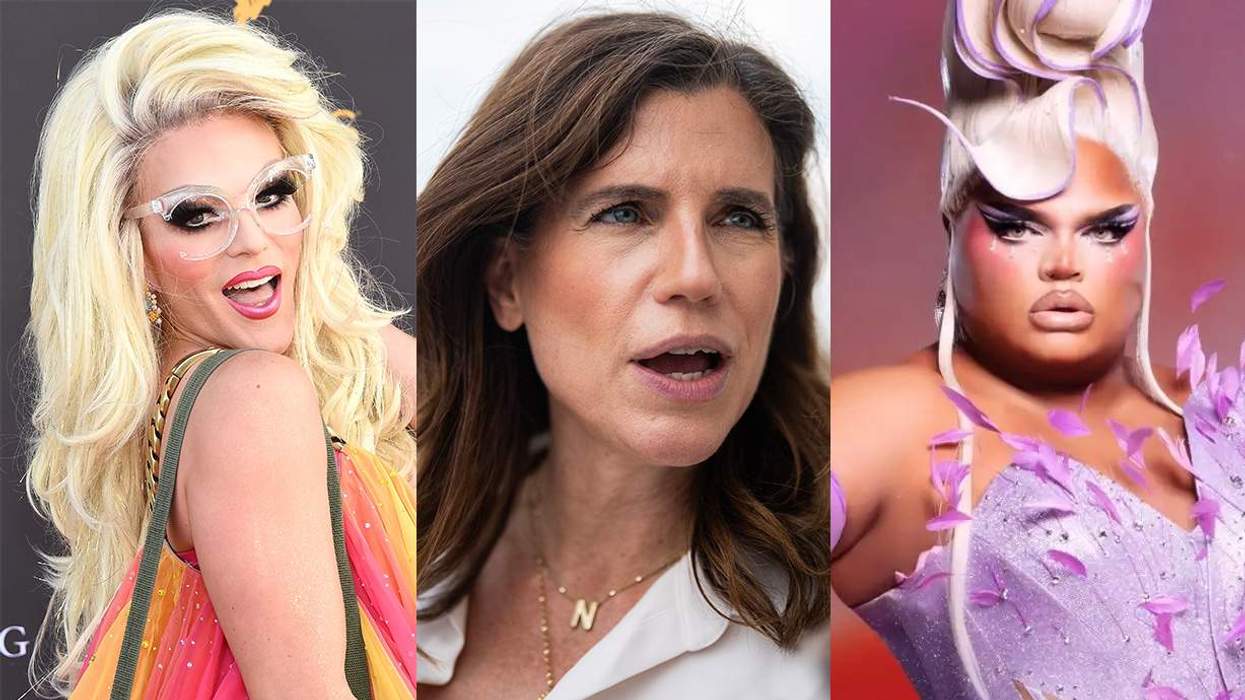
The South Carolina conservative drew attention during a congressional hearing when she displayed photographs of Drag Race host RuPaul and stars Kandy Muse and Joey Jay as she argued that drag “sexualizes” children.
In a subcommittee hearing Tuesday, examining the Trump administration’s assertion that the Smithsonian is insufficiently patriotic, Republican Rep. Tim Burchett said the institution had "become infected by a woke ideology." Mace criticized the National Museum of American History for displaying a photo of drag legend and Emmy-winner RuPaul.
“RuPaul is a man that dresses like a woman, literally," Mace said, before launching into an attack on drag queens which relied on the tried and true GOP rhetoric that equates LGBTQ+ people and drag queens with child predators.
"Do you know how many kids get raped by adults in this country?" she asked during the hearing. Mace went on to argue that displaying photos of drag queens for children puts them at risk. "Putting this kind of crap in front of kids sexualizes them," she said. "Makes them vulnerable to people who wanna abuse them."
The queens didn’t take the insult from the loudest and proudest anti-trans Republican lying down. RuPaul has yet to comment, but both Kandy Muse and Joey Jay clapped back on X (formerly Twitter).
Kandy Muse wrote, “can I sue?” along with a reposted image of Mace holding up their photos at the House hearing. Joey Jay took things a step further when she commented, “I’m talking with my lawyer I’ll let you know what he says.”
Other Drag Race stars also weighed in after the Here’s Why Kevin Instagram account posted a clip from the hearing.
Willam wrote in the comments under the video, “the continental congress wore wigs and heeled shoes. they’re in the museum and didn’t want to rape kids did they? well other than thomas jefferson but besides the point.”
Cynthia Lee Fontaine also wrote a comment, reminding Mace that she might want to pay closer attention to the child sexual abuse happening in churches instead of what drag queens are doing.
"@repnancymace instead of focus on artist who do female illusionist that do more for the society in general and contribute culturally to the history of our country, why don’t invest your time in education and also getting churches investigated for sexual abuse and conversion therapies damaging children by the pastors. This last groups I mentioned are really a HARM to children. Get your facts right sweetie," she wrote.
Mace, who has built her career in Congress around attacking the trans community, held up the photos of drag queens and a leather harness as part of the Republican led committee’s attack on a temporary Smithsonian exhibit that closed in 2021 called “Illegal to Be You: Gay History Beyond Stonewall,” which explored the criminalization of queer people and the fight for equality.
Smithsonian Director Anthea Hartig defended the exhibit, explaining that everyone under 18 had to be accompanied by an adult and that “no one complained” during the exhibit’s run at the museum.