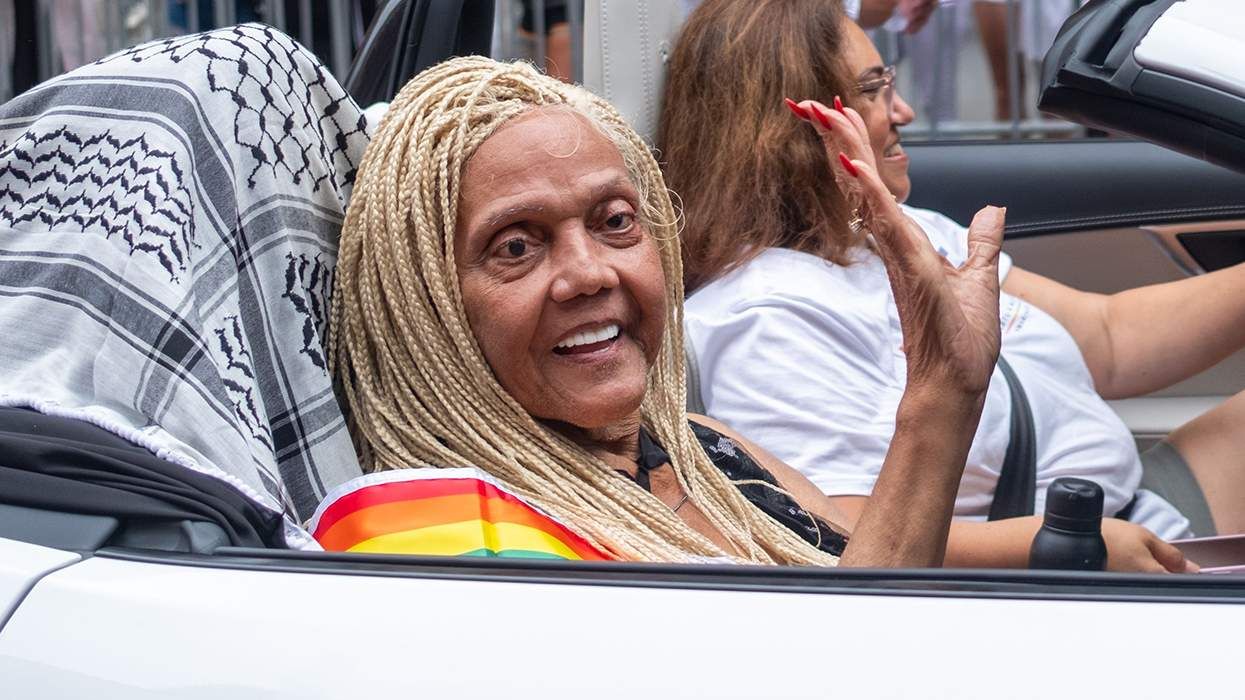










































Miss Major Griffin-Gracy, a legendary transgender activist who had been in the movement since Stonewall, died Monday at age 78.
Her death was announced by the House of GG—Griffin-Gracy Retreat and Educational Center, which she founded. She died "in the comfort of her home and surrounded by loved ones in Little Rock, Arkansas," says a statement from the center. "Her enduring legacy is a testament to her resilience, activism, and dedication to creating safe spaces for Black trans communities and all trans people — we are eternally grateful for Miss Major's life, her contributions and how deeply she poured into those she loved."
Miss Major had suffered from health problems for some time and had recently begun receiving hospice care.
She spent more than 50 years fighting for the "trans, gender-nonconforming, and LGB community — especially for Black trans women, trans women of color and those who have survived incarceration and police brutality," the statement continues. Major’s fierce commitment and intersectional approach to justice brought her to care directly for people with HIV/AIDS in New York in the early 1980s, and later to drive San Francisco’s first mobile needle exchange. As director of the TGI Justice Project, she’d return to prisons as a mentor to her ‘gurls’ inside."
She founded House of GG in 2019 as "a space for our community to take a break, swim, enjoy good food, laugh, listen to music, watch movies, and recharge for the ongoing fight for our lives," the statement goes on. "Miss Major fought tirelessly for her people, her love as vast and enduring as the universe she knew herself to be a part of. She was a world builder, a visionary, and unwavering in her devotion to making freedom possible for Black, trans, formerly and currently incarcerated people as well as the larger trans and LGB community. Because of her, countless new possibilities have been made for all of us to thrive — today and for generations to come. She affirmed that our lives hold meaning and that we stand on the shoulders of giants like her, whose courageous love and relentless fight assured our right to live with dignity. We will forever honor her memory, her steadfast presence, and her enduring commitment to our collective liberation."
Miss Major was born October 25, 1946, in Chicago, according to her memoir Miss Major Speaks: Conversations With a Black Trans Revolutionary, written with Toshio Meronek. She was assigned male at birth but knew her true gender was female from an early age, even though she didn’t always have words for it.
She graduated from high school at age 16 and entered college in Minnesota but ran into trouble because she possessed female clothing. In 1962, she moved to New York City, where she worked briefly in a hospital morgue and performed in drag shows, including the Apollo Theater’s famous Jewel Box Review. She also became a sex worker.
Related: What Trans Elder Miss Major Griffin-Gracy Wants You to Know
She participated in the Stonewall uprising of 1969, in which LGBTQ+ people stood up against police harassment at the Stonewall Inn in NYC’s Greenwich Village. Police raids were common, but “I guess we were just sick of their shit,” she said in Miss Major Speaks. “And suddenly we were fighting, and we were kicking their ass.” But the gay rights movement that grew out of Stonewall excluded trans people, she observed in the book.
Later arrested on a robbery charge, she spent time in men’s prisons and mental hospitals in the early 1970s, and she was often severely mistreated. In one of them, however, she met Frank “Big Black” Smith, one of the leaders of the rebellion at the Attica Correctional Facility in New York State, and she has said this experience made her a political person. Upon regaining her freedom, she became an advocate for incarcerated trans people, especially trans women housed in men’s prisons and those who have survived police brutality. She was the first executive director of the Transgender Gender-Variant and Intersex Justice Project, a role she held until she retired in 2015. In that capacity, she often visited trans prisoners and became a mentor to them.
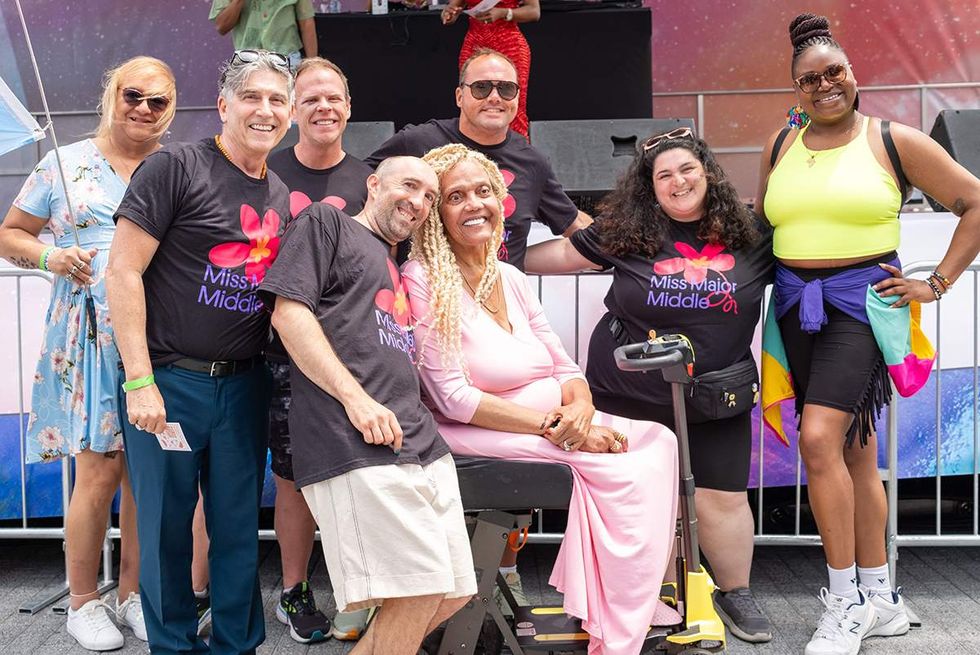 Miss Major Griffin-Gracy (pictured center, in pink) with members of the community during NYC LGBTQ+ Pride festival, 2024Wirestock Creators/Shutterstock
In the 1980s, Miss Major became involved in addressing the AIDS crisis, first in New York. After moving to San Diego with her son Christopher, she started a home health care agency, Angels of Care, to assist people with the disease. She lost a partner, Joe-Bob Michael, to AIDS in 1995. Relocating to San Francisco, she became a health educator with the Tenderloin AIDS Resource Center. She started a drop-in program there for trans people, called GiGi’s Place, and she did street outreach to those who weren’t comfortable with coming to the center. She moved to Little Rock in 2016.
Related: 'Enough is Enough' 10 LGBTQ+ Elders Share Their Words of Wisdom
While Miss Major was often critical of the American political system and the mainstream LGBTQ+ rights movement, she did address the LGBTQ+ Caucus at the Democratic National Convention in Chicago last year. In a powerful and passionate speech, she urged attendees to “put on your best shit and get out there” to defeat Donald Trump.
“I’m not going back. I refuse to go back. And if [Trump] thinks we’re going back, fuck him in his ass,” she said to much applause. She endorsed Kamala Harris for president.
In addition to Christopher, Miss Major is survived by her longtime partner, Beck Witt; sons Asaiah and Jonathon; her many daughters, including Janetta Johnson, her successor at the Miss Major Alexander L. Lee TGIJP Black Trans Cultural Center; her sisters, Tracie O’Brien and Billie Cooper; keeper of spare parts Thom Jeffress; countless community members of who have been shaped by her mentorship and legacy as a leader; and a whole host of family and friends, the statement notes.
Miss Major maintained a sense of joy throughout her life, Meronek wrote in her introduction to their book. “Her joy comes from a place I don’t fully understand,” Meronek observed. “Despite her taste for the macabre — the Saw series of movies are her favorites — she always tempers the dark with earnest sentimentality and optimism.”