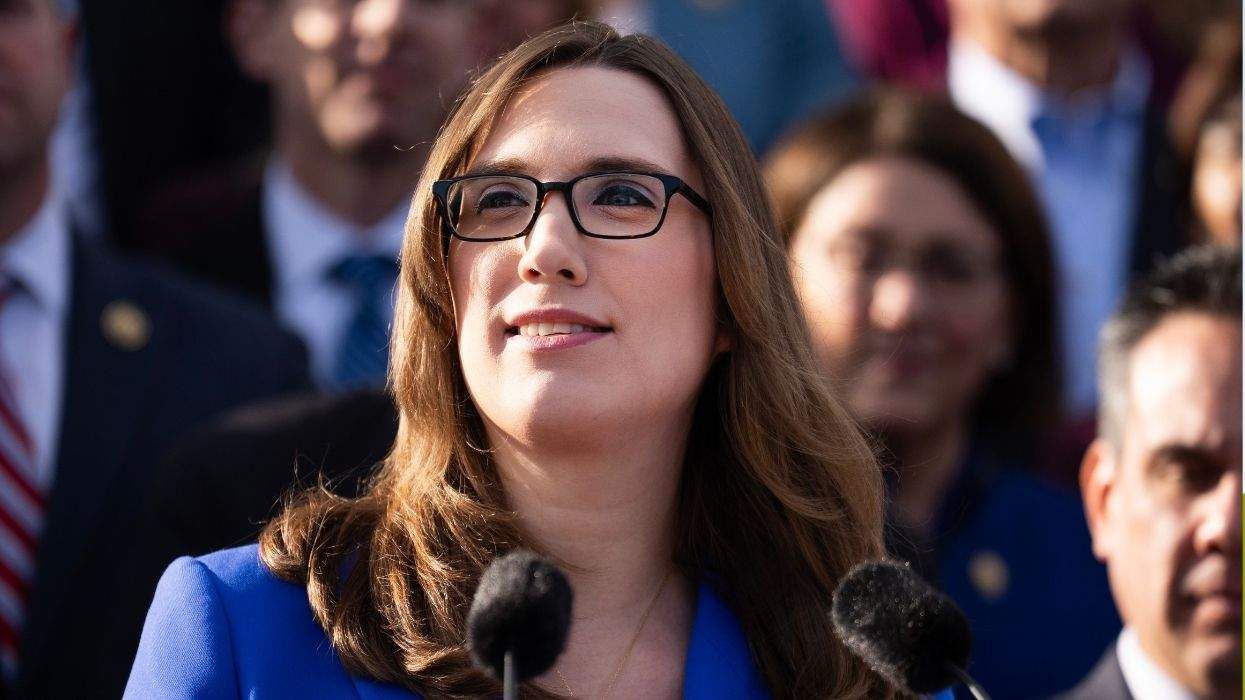








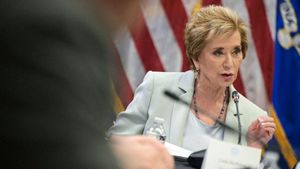

































In her first year in Congress, Delaware Rep. Sarah McBride says she's tried to do something that feels almost impossible in American politics: lower the temperature in a political environment built to reward outrage. As one of the most visible transgender people in the country, and the first out trans member of the U.S. House (and Congress as a whole), McBride has become a test case for a political strategy grounded in persuasion, restraint, and expansion rather than confrontation.
Keep up with the latest in LGBTQ+ news and politics. Sign up for The Advocate's email newsletter.
“I’ve entered Congress at an incredibly dangerous time for our country,” she told The Advocate in a recent interview. “The cultural momentum that it felt like we had in the 2010s has given way to a cruelty and cultural regression that I don’t know that we’ve seen since the 1800s.”
Related: Sarah McBride opens up about her darkest day in Congress (exclusive)
Her tenure so far has been shaped by personal and political whiplash: the high of her historic election and orientation followed almost immediately by a wave of anti-trans bathroom-related stunts and attacks from far-right lawmakers attempting to provoke a viral clash. She now describes that episode as one of the deepest lows of her life, rivaling the grief she has experienced after the death of her husband. However, she also explains that it clarified her approach.
McBride refused to take the bait. “It has undeniably been successful,” she said, noting that the attacks decreased once it became clear she would not deliver the performative confrontation her detractors hoped for.
What mattered more, she said, was the imagery: “The country needs very clear visual contrast between the inhumanity of anti-equality politicians and our literal humanity.”
Why she doesn’t clap back, even when some want her to
If her restraint quieted her opponents, it inflamed some of her supporters — particularly some trans people who felt she wasn’t fighting hard enough in the face of humiliation. McBride does not pretend otherwise.
She said she understands exactly why some trans people wanted to see her “fight back visually,” as she put it, and why refusing that fight can feel unsatisfying. The desire for catharsis, to watch her enter a war of words with those attacking her, is something she speaks about with candor.
Related: Sarah McBride explains how Democrats’ ‘big tent is bisexual’
“I recognize that it’s not viscerally comforting for some people in my own community who feel the indignities that I am facing vicariously,” she said.
The lack of a sharp retort, she said, can make her strategy appear passive.
“I recognize that in that moment it can feel unsatisfying, even disempowering, and that’s unfortunate,” she added. “But leadership requires us to do things that aren’t easy.”
McBride is transparent about the internal tension — the gap between what feels emotionally gratifying and what she believes will build lasting public support.
“Sometimes it’s a clap back,” she said. “Sometimes it’s summoning the power and discipline not to.”
She also understands the critics who question whether she is being “properly” trans enough in the halls of Congress. McBride said she hears the criticism, but there are different ways to make change.
McBride is equally clear that her strategy — private conversations, public composure, persuasion over spectacle — is a deliberate choice.
In 2023, as a state senator in Delaware, McBride was able to successfully get Republicans to join Democrats to pass a law that made the state the 17th to reject the gay and trans panic defense.
A bigger tent, even when it’s uncomfortable
McBride’s broader argument is one she has been making for months: the Democratic Party cannot win lasting protections for LGBTQ+, particularly trans, people unless it expands its coalition to include voters who may feel uneasy or unfamiliar with transgender identities.
Related: 'A betrayal': Trans people respond to Sarah McBride's bathroom ban compliance
She told The Advocate that Democrats often struggle because some voters don’t feel the party likes them. “Does this candidate like me?” she said, arguing that if Democrats cannot answer yes, “they won’t even get to the second question.”
She repeated the point earlier this month at Crooked Con, where she described the party’s “big tent” as “bisexual — it goes both ways,” meaning Democrats must be welcoming in all directions, not only toward those who already agree with them.
In June, McBride told New York Times columnist Ezra Klein that she believes that the trans rights movement may have been getting ahead of itself. “I think that’s an accurate reflection of the overplaying of the hand in some ways — that we as a coalition went to Trans 201, Trans 301, when people were still at a very much Trans 101 stage,” she said. “I think some of the cultural mores and norms that started to develop around inclusion of trans people were probably premature for a lot of people. We became absolutist — not just on trans rights but across the progressive movement — and we forgot that in a democracy we have to grapple with where the public authentically is and actually engage with it.”
In her interview with The Advocate, she drew a sharp line between anti-trans politicians and voters who hold complicated, sometimes contradictory views. Treating those voters as indistinguishable from the far right, she said, is both politically disastrous and morally shortsighted.
“If you lump everyone who is still on a journey with the far right-wing politicians,” she said, “you’re pushing those voters toward those right-wing politicians. “I have never successfully convinced someone by starting a conversation with, ‘You are a bigot and every concern you have is ridiculous.’”
Pressure politics
On Tuesday, 213 House Democrats, including the entire party leadership, sent a letter to Speaker Mike Johnson, the Louisiana Republican, demanding he intervene to stop the rising tide of anti-trans rhetoric on the House floor and in committee hearings. Republican members have repeatedly used slurs and promoted conspiratorial claims about transgender Americans during official proceedings, in violation of House rules, the signatories said.
Related: Sarah McBride wins Delaware U.S. House seat, becoming the first out trans member of Congress
The scale of the response is one of the broadest coalitions of Democrats assembled this Congress, and it may signal shifting power dynamics in the battle over trans rights. For McBride’s strategy, the letter underscores her belief: The moment is not only about responding to individual attacks, but about changing the structural climate in which those attacks occur.
It also places her work in sharper relief. The public display of unity among Democrats — nearly the entire party in the House — contrasts with the quieter, persuasion-based work McBride is doing with voters. While the letter calls for enforcing decorum, McBride’s ground game calls for engaging voters whose anxiety Republicans have stoked.
“Transgender people deserve government officials who will lift them up, not attack them simply because of who they are,” the letter stated.
The personal risk and the ground-level support
With growing visibility comes heightened vulnerability. McBride said she worries about her safety.
“I would be lying if I said that I don’t worry about it,” she said, but ultimately decided that stepping back would concede the political arena to those who want trans people silenced.
“If they can successfully intimidate us out of public life,” she said, “that is a surefire way for us to not only be pushed back into the shadows, but to see a politics that is perhaps unstoppably cruel toward us.”
Related: Sarah McBride slams Republicans for blocking amendments on trans military service in defense bill
Yet she is buoyed by the reception she receives across Delaware, especially at Wawa, the popular convenience store, where she says every visit brings a message of support. The gap between online criticism and real-world solidarity is vast, she said.
“When I’m physically with other LGBTQ people, it is a fundamentally different proportion of people than when you go online and open BlueSky.”