



































Historically, the media has had a hard time wrapping its head around the concept of bisexuality. Much mainstream media still lives very much in the binary and has a hard time representing anything outside of it. While representation of marginalized populations in media has improved in some cases, there is still a long way to go, and in this specific case, it speaks to the larger societal issue of “bisexual erasure.”
It’s also affirming to see your identity represented on screen. This was certainly the experience I had, as someone who did not truly accept the fact that I was bisexual well into my 20s. There was very little representation, and oftentimes bisexuality was just a stand-in for someone who was confused about their sexuality and who would ultimately come out as gay. Always in the binary. Yet one director has consistently been showcasing characters who are bi or who do not simply identify as gay or straight, and that is the Dutch genre director Paul Verhoeven.
Verhoeven has always pushed boundaries in his work. If you look through his filmography, you will find common themes such as criticism of fascism, social satire, critiques of organized religion, as well as showcasing sex and sex work. He has frequently critiqued American studios for their puritanical views on sex, saying things like, “There is a fear of sexuality and the portrayal of sexuality, though we are well aware that without sexuality there would not be a species,” to New Yorker.. He is also concerned about the overall tone of the studios: “American cinema today is missing all existential thought. There's no questioning society. No politics. Studios try to make themselves feel good with the movies that make it to the Oscars,” he said in an interview with The Playlist.
It is hard to argue with these statements, especially when the biggest money-makers over the last decade are sanitized superhero movies and children’s films. Given Verhoeven’s views on representation, pushing boundaries, making people uncomfortable, and trying to show that which people are afraid to show, it is not much of a surprise that the director would also push up against the binary of sexual orientation.
Although the sexuality of his characters is not always explicitly stated, we often see them engage in or explore sexuality in much more of a gray area than is common, especially in works like Basic Instinct, The 4th Man, Showgirls, and his most recent film, Benedetta. All of these works showed me that while bi representation has been scarce in film history, there were those like Verhoeven who pushed those boundaries, and that has opened up space for us to see more vocally bisexual or sexually fluid folks depicted on screen.
THE 4TH MAN & BASIC INSTINCT
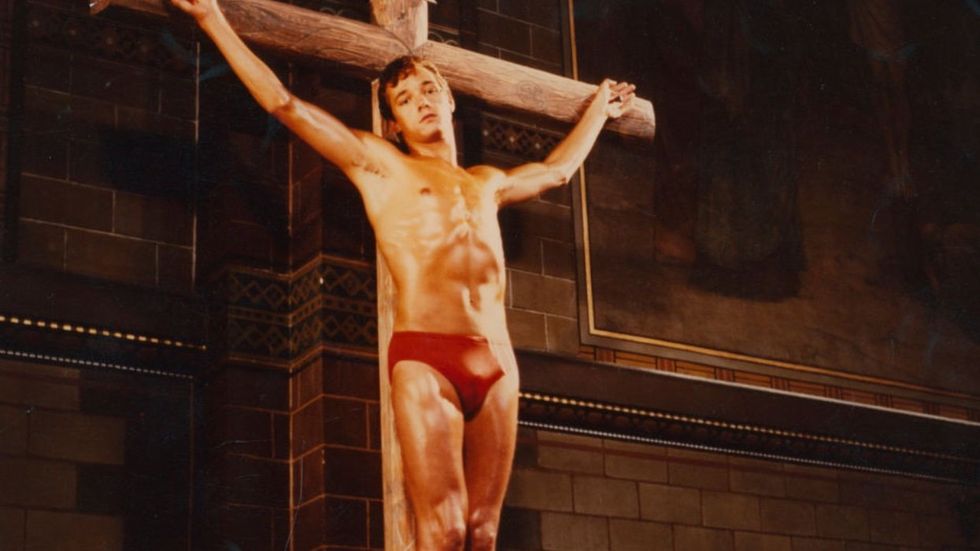
The 4th Man
Tuschinski Film
Before making a splash in the States, Verhoeven built up quite the filmography in the Netherlands. In 1983, he directed The 4th Man, a film about a writer who has an affair with a woman whose husbands have all mysteriously died. As opposed to his other films that have mainly showcased women exploring sex outside the binary, in this case it is the main character, Gerard. Early on, we watch Gerard cruising a younger man named Herman. While his attempt is unsuccessful, they later meet and engage in oral sex in a tomb. Gerard has various religious visions throughout the movie, but in one particularly memorable scene, Gerard has a sexual fantasy of Jesus on the crucifix (wearing a Speedo instead of a loincloth). While Gerard likes the attention he receives from the young, rich, and beautiful Christine, the hope of seducing her other lover, Herman, is what ultimately keeps him around.
The 4th Man has many similarities with another film about an attractive femme fatale, Basic Instinct. In this case, the bisexual character is Catherine Trammell, famously played by Sharon Stone.
On its surface, it is an interesting choice to switch the sexual orientation of the protagonist and antagonist, but that may not have been Verhoeven’s intention. On top of declining to go full frontal for his role as Det. Nick Curran, Michael Douglas also refused to let his character be bisexual. It is unclear how this would have changed the overall story, but it does seem to make sense that when Verhoeven came to America, they were more willing to show a film with women having sex than they were with two men.
If anything is going on between Verhoeven’s other male characters in his films, it has been mainly coded from here on out.
SHOWGIRLS
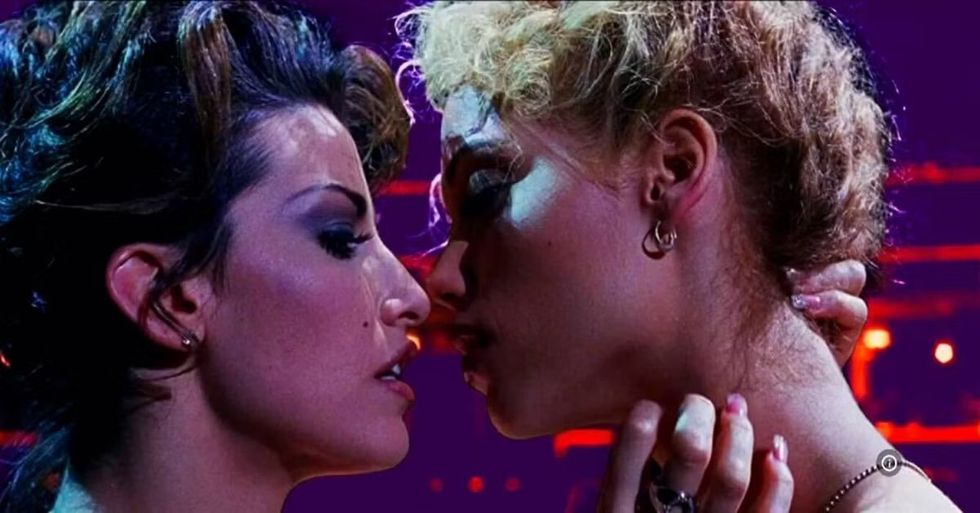
Showgirls
MGM
The much less explicit but still sexually charged relationship between Nomi (Elizabeth Berkley) and Cristal (Gina Gershon) in the controversial movie Showgirls also points to how society puts women against each other. One reason Showgirls felt so scandalous when it was released in 1995 was the fact that, in order to maintain creative freedom over the production, Verhoeven was promised an NC-17 rating from the beginning.
In the film, it is made clear that Cristal is bisexual, but because of the dog-eat-dog industry they are in, women are in constant competition with one another, making them constant enemies even when there is an attraction between them.
Showgirls does a great job at showing how patriarchal American society—and the show business industry specifically—objectifies women. The relationship between Cristal and Nomi is constantly antagonistic, with each of them working to humiliate and tear down the other in their scramble to the top. It is not until the end, when both of them have turned their back on the industry, that they reconcile with a romantic kiss.
Watching Showgirls now reminds me that I was not just a “straight girl that had crushes on women,” and being more authentically myself lets me take up more space in the world.
Verhoeven said that Showgirls was his most realistic film about American society. The fact that Elizabeth Berkley’s role as Nomi essentially destroyed her career shows how true the stories about the industry really are, and how women can never seem to win when toeing the line between innocent and sexual. It also points to how bisexual women have often been painted as more sexually aggressive.
To make Showgirls, Verhoeven and writer Joe Eszterhas did extensive interviews with people working in the Las Vegas show business industry. He would later base another film on true accounts for his sensational depiction of a nun and her sexual religious visions in Benedetta.
BENEDETTA
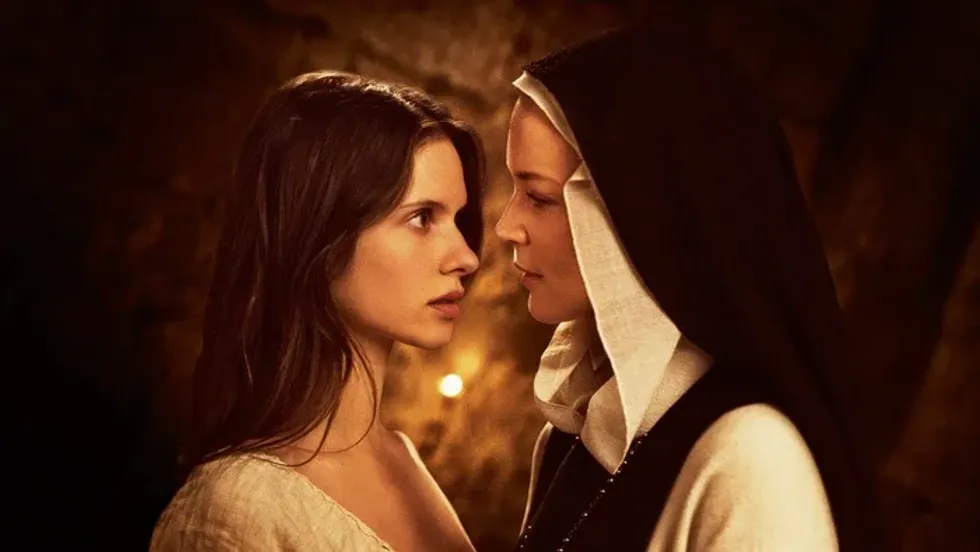
Benedetta
IFC FILMS
Benedetta is based on Judith C. Brown’s book, which includes interrogations of two women in 17th-century Italy. The testimonies were very detailed, down to exactly what the women did in bed. One of the most controversial elements of the film is the sex toy they crafted from a Virgin Mary statuette, and the fact that they hid the dildo in a hollowed-out Bible.
According to Brown’s book, lesbian acts were always punished, but the use of an “instrument” was actually punishable by death. While Benedetta (Virginie Efira) does have an intense sexual relationship with another nun, Bartolomea (Daphné Patakia), her religious “visions” feel more like sexual fantasies of a beautiful, buff, greased-up Jesus Christ.
It may be hard for some to believe that those who choose the celibate path find ways to gratify themselves sexually; historically speaking, it is not at all far-fetched. Thirty-eight years after The 4th Man, Verhoeven is still finding ways to rile up the prudish, and in this case, the fact that what the film was based on historical accounts gave him even more of a leg to stand on, as he says, “You cannot change history after the fact. It's done — people have done that ... So I think the word blasphemy.’ For me, in this case, is stupid,” he said during a press conference at Cannes in 2021.
While these films are the most prominent cases of bisexuality in Verhoeven’s filmography, there are certainly coded relationships and sexual exploration in many others. Many of his films feature love triangles that today feel closer to a potential throuple than anything.
But perhaps most revelatory of all is that in Verhoeven’s work, there is no specific moral message that answers whether these relationships are “good” or “bad”; they simply exist. Just as any of us who represent marginalized groups simply exist.
Verhoeven’s childhood was shaped by living through WWII in Nazi-occupied Netherlands, where he witnessed terrible atrocities play out in front of him. So, it is not hard to imagine why he is so critical of censorship, especially when we see history constantly repeating itself.
His work is a reminder that we need instigators to rile things up and try to show what our sanitized moralistic society does not want to show: real life. As Verhoeven says in an interview with Variety discussing Benedetta: “Homosexuality is part of life, so it should be a part of our dramas. Why should I ignore that? It’s there. A certain part of the population is bisexual, or homosexual, or transgender, that’s the reality. I come back to it because it’s a normal part of life.”
His frankness in these moments is refreshing and affirming. But it does not have to be sensational. Visibility is only one part of equity and inclusion work, though it is an important one. Verhoeven has been pushing these boundaries for decades. In a time when we are still debating if seeing sex on film is “bad,” it is clear that we need to keep pushing the envelope and try to fight back against those stuck in binary and morality, and simply show what is real. And yes, that includes bisexuality.


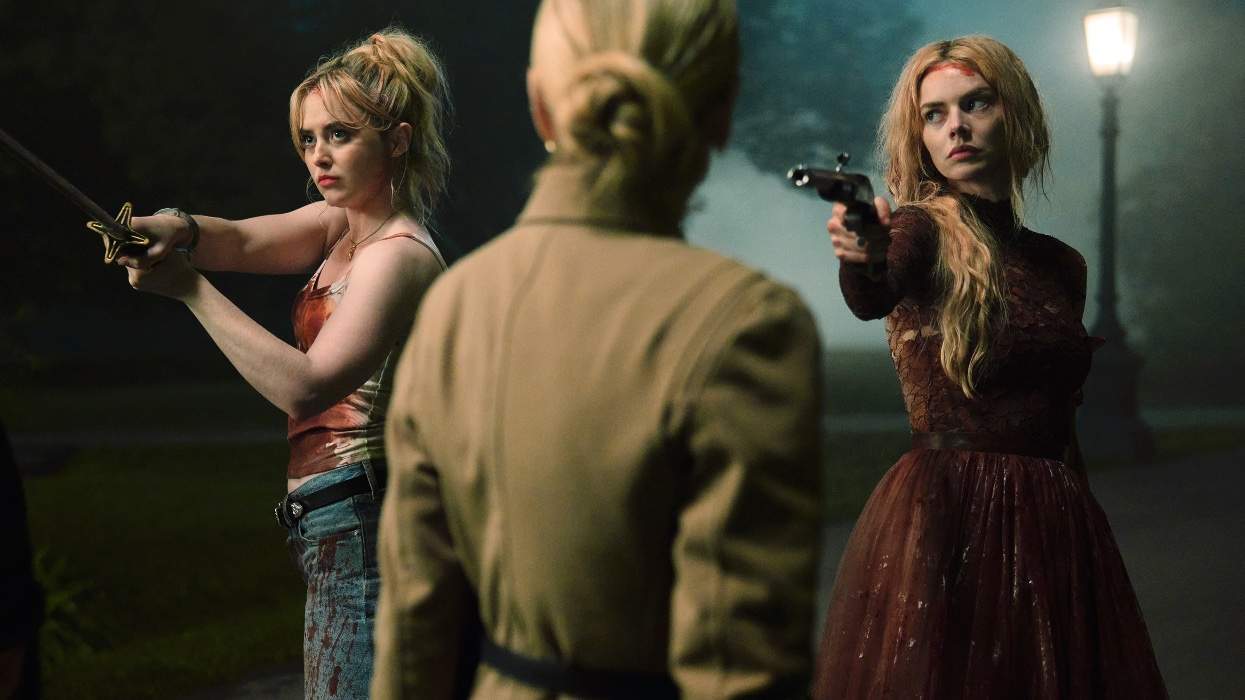
 Samara Weaving and Kathryn Newton.Searchlight Pictures/Pief Weyman
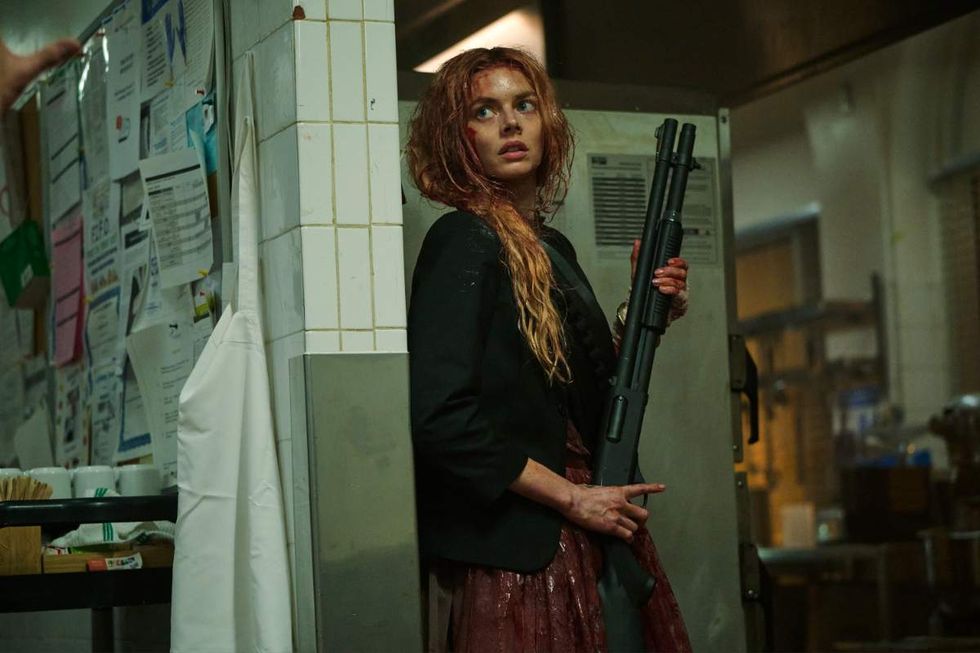 Samara Weaving.Searchlight Pictures/Pief Weyman
 Nestor Carbonell, Sarah Michelle Gellar, Shawn Hatosy, Elijah Wood, and Nadeem Umar-Khitab.Searchlight Pictures/Pief Weyman
 Daniel Beirne, David Cronenberg (portrait) Shawn Hatosy, and Sarah Michelle Gellar.Searchlight Pictures/Pief Weyman
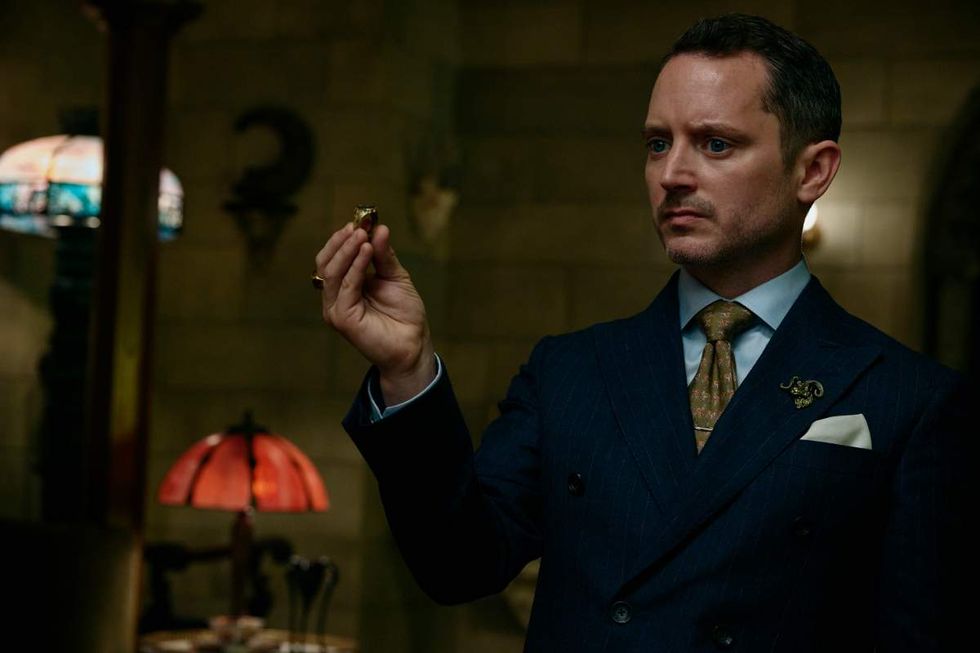 Elijah Wood.Searchlight Pictures/Pief Weyman
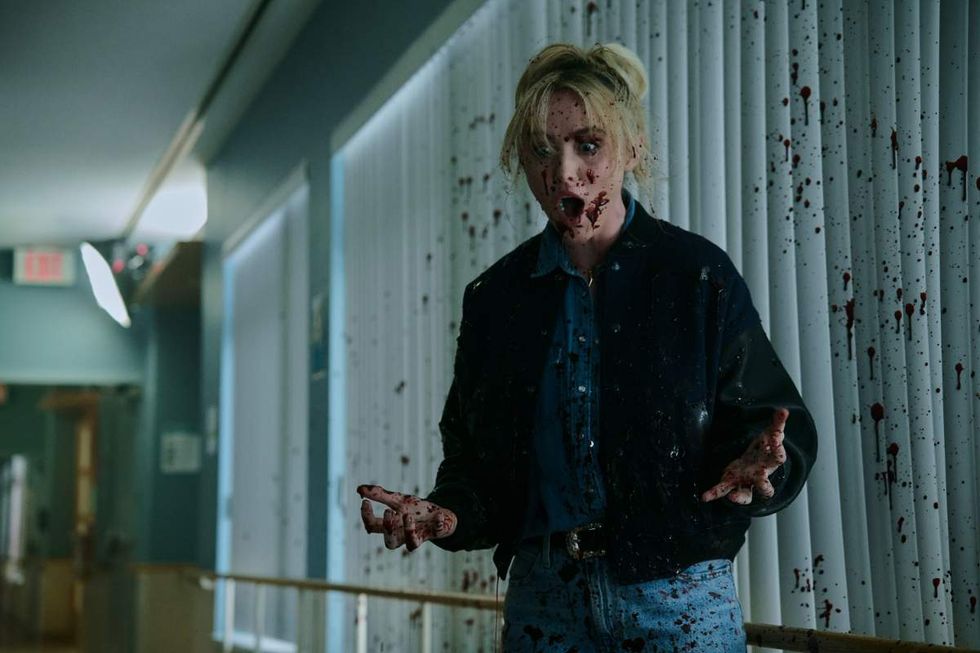 Kathryn Newton.Searchlight Pictures/Pief Weyman