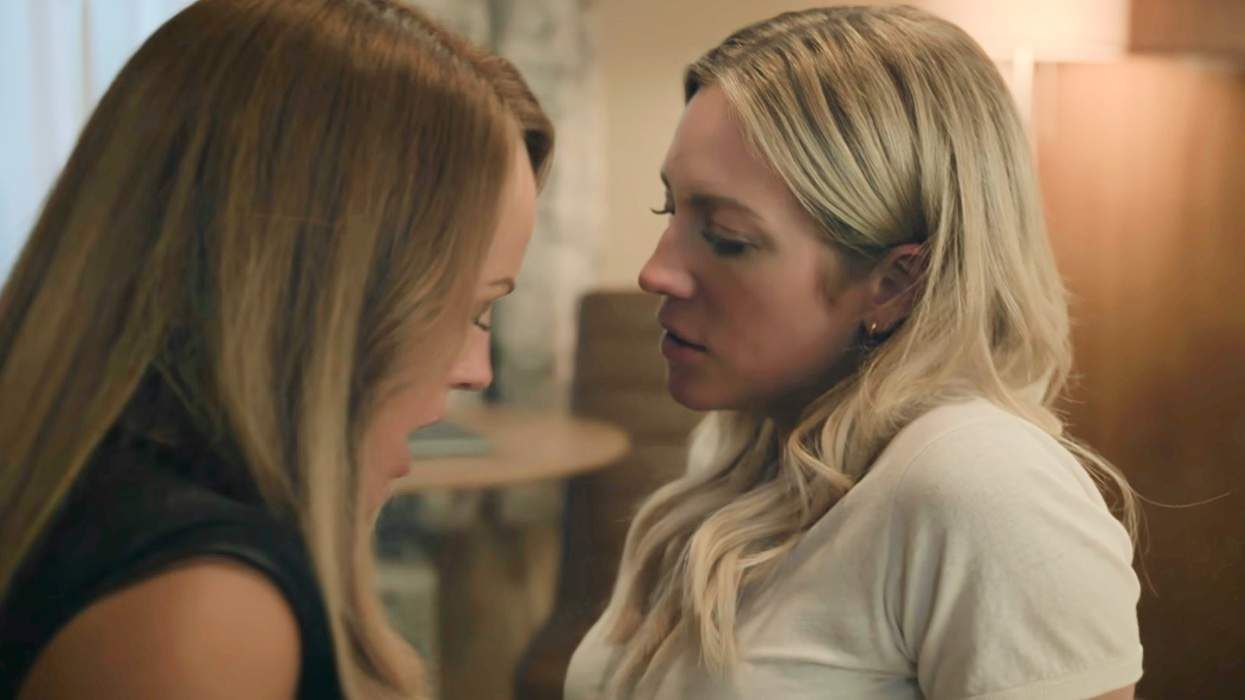






















This week, Tina Romero’s highly anticipated queer zom-com Queens of the Dead is finally headed to theaters, and LGBTQ+ audiences are in for quite a spooky, hilarious, and heart-warming treat. It’s queer joy at the end of the world, in a moment when we could use a little extra.
The film is set in the queer nightlife of Bushwick, New York, and follows a group of nightlife entertainers including a club promoter named Dre (Katy O’Brian), her second-in-command (Jack Haven), bartender (Cheyenne Jackson), and a bevy of performers and queer folks played by beloved out actors including Dominique Jackson, Jaquel Spivey, and Margaret Cho who are faced with the unthinkable: surviving a zombie apocalypse.
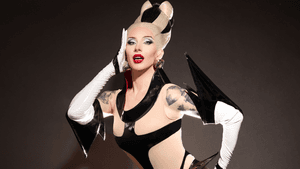
Two of the film's breakout performances come from drag artist Nina West and Tomás Matos, who play a drag queen (Gincey) and a go-go dancer (Nico), respectively.
Inspiring and joyful at any time, there’s something particularly poignant about seeing unapologetically queer, non-gender-conforming characters who represent staples of queer life, and that are so beloved by our community, finally getting their due as heroes on the big screen. It’s not lost on either of the actors, who recognize just how equally revolutionary and joyful the film is.
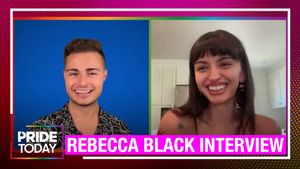
PRIDE sat down with Nina and Matos to talk about what it meant to be on an almost entirely queer set, how this film both paid homage to queer history and set a blueprint for our future in these turbulent times, and all the queer shenanigans happening between takes — and, no surprise, there were a whole lot.

Dominque Jackson, Nina West, Tomás Matos, Quincy Dunn-Baker, Katy O'Brian, and Jaquel Spivey in 'Queens of the Dead'
Courtesy of Shannon Madden
PRIDE: This film is so authentically queer. Both of you play characters that are kind of heroes within the queer community: go-go dancers and drag queens. They represent queer joy, queer visibility, a celebration of our sexuality, and are at the forefront in terms of rejecting respectability politics and also being politically active. I'm curious for each of you, how is it to get to take these archetypes of our community and represent them as heroic in a cinematic sense?
NINA WEST: That's about how we felt about it. That's how we treated it. There was something so sacred and also so freeing about having the ability to step on screen in some of these roles that I think are so important to our community... what an honor, all of those things, what an honor to be able to do this on screen.
TOMÁS MATOS: When you think of nightlife, and you think of queer nightlife specifically, the people who are most visible are the workers, aka the drag queens, the club kids, the go-go dancers, the promoters, the people behind the bar, who are all pinpointed in this film. So it makes sense for us to be able to tell those stories, because they would be the ones to help usher the scenario of what would happen during a zombie apocalypse at a Brooklyn nightlife club.
I also think it's super important for those stories to be told, mainly because, when you think of horror films in general, queer people tend to be depicted in a specific way. With this film, we were able to reclaim that and tell our own stories and see what it looks like through our own lens.
I got so much queer joy from the experience of watching this because of an understanding of queer culture that only comes from lived experience. One of the most poignant moments in the film that really highlights this is when the characters throw a dance party when it seems all hope is lost. That’s something that is ripped from our history throughout the AIDS crisis. I'm curious, in this moment that in some ways reflects some pretty dark times, what do you hope queer audiences take away from seeing that kind of resilience in this film?
NW: It is echoing exactly what you’ve mentioned, which is how did we get through the AIDS crisis? Right? We picketed and we fought and we protested during the day, and we danced at night. That history is vital and really important. And I think [screenwriter] Erin Judge and Tina did a huge, huge service to all of us who were in the film and to the audience.
Who knew that this film would be coming out during this time period, but the fact that we have the ability to actually talk about it in this context right now in this interview. Which is to say: it is going to be darker before the dawn. But that doesn't mean that we shouldn't dance. We shouldn't hold each other, we shouldn't celebrate, we shouldn't speak our queer joy into the world. We shouldn't lift each other up. We shouldn't remind each other of our histories and our stories, because we should. We should be doing all of these things, all while kicking some zombie ass if that zombie means, actually, this administration's ass, and holding them to account.
TM: I would agree with everything Nina just said. When you think of this film and the zombies, what they're [representing] in this film, you could replace the word zombie with bigot. You could replace the word zombie with our oppressors. You could replace the word zombie with this current administration, and it would still ring true. So, if there's anything that queer people take from this film, I hope it's that, yes, I want it to enact joy when people watch it. But I also would like for it to kind of be a catalyst for people who maybe feel a bit unseen, maybe feel a bit like they don't have a voice in what's happening today. I hope that they can see that we are fighting zombies in this film, and they could be fighting this administration today.
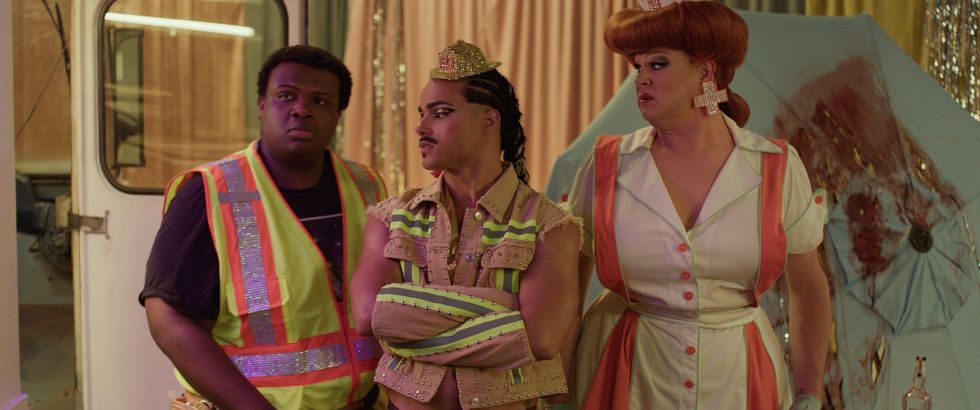
Jaquel Spivey, Tomás Matos, Nina West in 'Queens of the Dead'
Courtesy of Shannon Madden
I love that. It's such an incredible way for Tina to carry on her father's legacy of taking the zombie and really creating a political sort of allegory from it. But you touched on something, which is also the queer joy. One of the things that comes through on the screen is just how queer the set was. Tell me about the experience of being on a set like that, just surrounded by community.
TM: I think it’s what’s necessary in order to feel the queer joy through the screen; not only to see the cast be predominantly queer actors, but also the [director of photography] being a queer person, you know, the head of props being a queer person. Putting more queer people and queer voices in positions of leadership when it comes to creating a film is what actually will end up helping us tell our stories—not only giving us a platform but allowing us to create that platform.
NW: I was so nervous walking on set, because I'm very green to film acting. Stage, sure. Film acting—it's a whole different art. And I was so nervous, and I walked on set, and I immediately exhaled, because everybody's queer, everybody's there to support each other. There were so many women on set, there were so many trans people on set, doing the work and holding each other up. I felt very, very safe, very comfortable, and able to make choices and decisions and feel supported in that work, because everyone else there had a lived experience that was maybe not like mine, but familiar enough that I knew we were all in it together, and we all had a language to speak that we all could understand one another.
I hope Hollywood takes note of this, of the magic that Tina intentionally created. It's all very intentional... no one was siloed off after they called cut. We were all sitting together, telling stories, becoming family, learning. It was an amazing communal experience.

Cheyenne Jackson and Nina West in 'Queens of the Dead'
IFC Films
I heard there were sing-alongs and even some TikTok dances. Do you have a favorite memory from that gay set?
NW: [Giggles suggestively]
Oh, Nina, whatever you just thought of, that’s the one I want to hear!
NW: Listen, I have loved Cheyenne Jackson. Cheyenne is a Broadway baby; the man was in All Shook Up. I mean, the man is just incredible. Off set, when cameras were down, we're [singing into] a fan doing our best Cher impressions, singing ABBA—it was just ridiculous. It was so silly and so much fun.
TM: My God, I have so many. We could literally create a reality TV show just based on the behind-the-scenes. We were having a time, whether it was me and Jack [Haven] doing the Charli [XCX] Apple dance, or once we called cut, me and Katy [O'Brian] would always play a game of throwing gummy bears at each other and seeing who could catch them in their mouths. I would always beat them, but that's just because I feel like I'm a good catcher.
This interview is lightly edited for length and clarity.