







































Elliot Tuttle's debut feature Blue Film tells the story of a camboy and a disgraced former teacher that challenges hubris, conjures horrors, and casually hijacks one's attention to keep up with the intense unfurling of a drama that moves like a thriller.
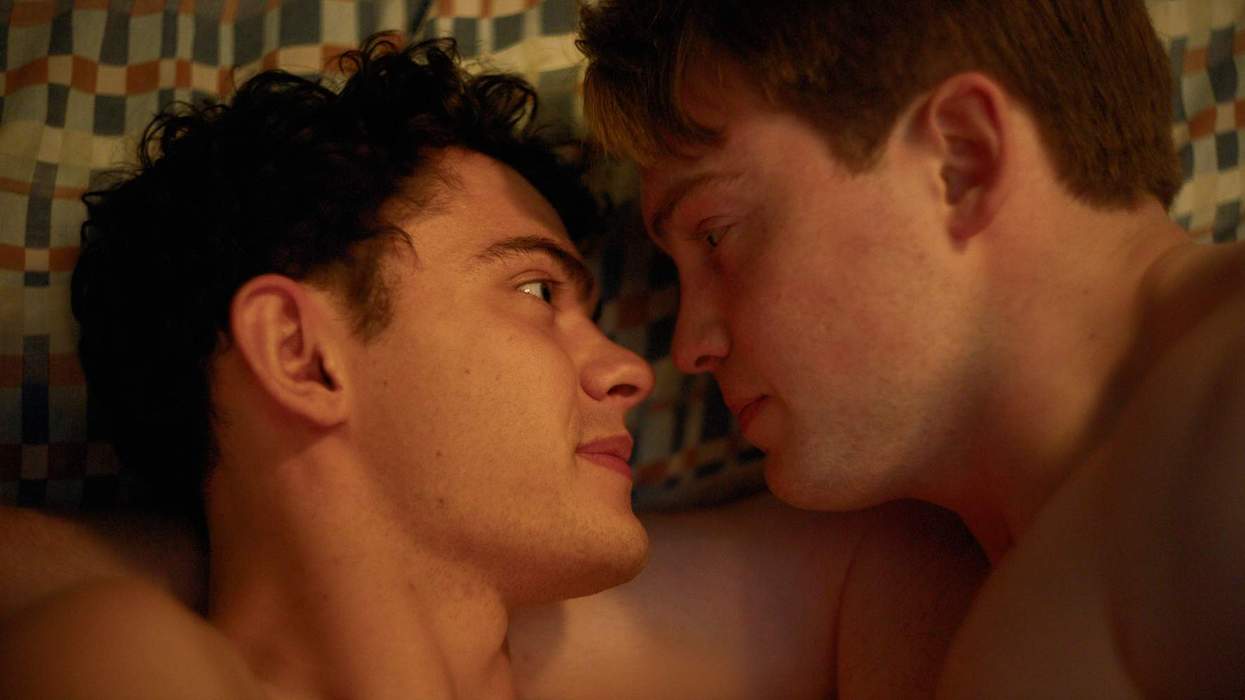
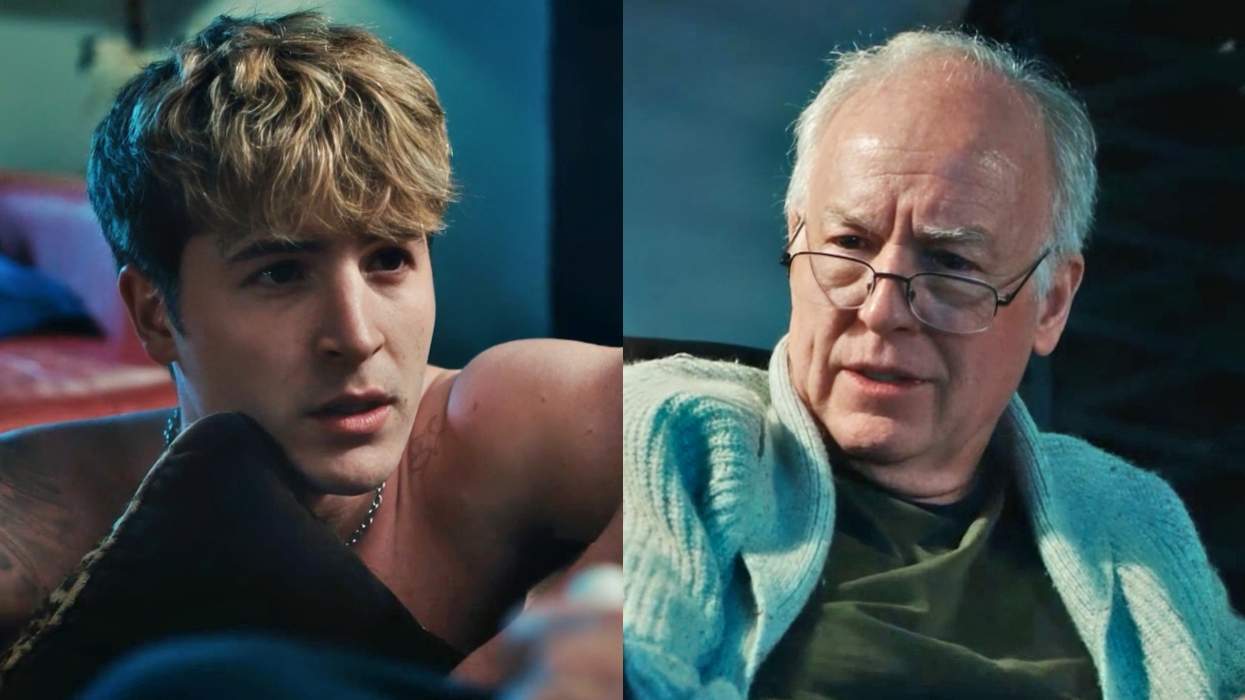
Starring Kieron Moore as Aaron Eagle and Reed Birney as Hank Grant, Blue Film is set over an increasingly suffocating night in a Los Angeles Airbnb. The movie has already received all sorts of responses from audiences and critics alike since it premiered at the Edinburgh International Film Festival — a polarized reaction that Tuttle was not only prepared for, but was actually curious about.
Tuttle, a Scorpio king who turned 26 a few days before our interview, was 24 when Blue Film was shot, and 23 when he wrote the movie. "The script feels very personal in the way that the Aaron character feels very personal to me," Tuttle tells Out about Moore's character. In turn, the filmmaker describes Hank (played by Birney) as a "vessel to navigate ideas about sex that I wanted to explore."
Those ideas are not coyly suggested, but they are also not literal. Much like it is the case with Hank, Aaron is a vessel for Tuttle to unpack certain stories, not a literal reflection of his own life story, nor intended to be representative of any specific gay man.
In that sense, Tuttle drew inspiration from filmmakers like Catherine Breillat (Fat Girl, Brief Crossing) and Michael Haneke (The Piano Teacher, Funny Games), referencing this "echo chamber" structure in Blue Film that entices audiences to be curious enough that they can sit through discomfort. "The film presents a lot of taboo conversations in very plain terms," Tuttle notes, observing that he understands why that can feel confrontational.
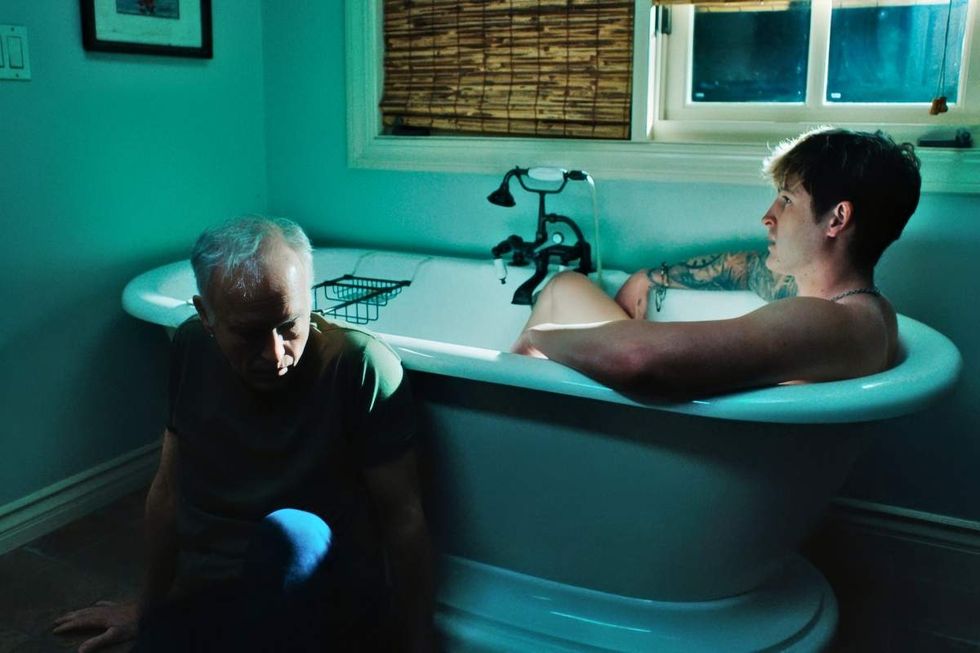 Reed Birney as Hank Grant and Kieron Moore as Aaron Eagle in Blue Film.Fusion Entertainment
And yet, the daring nature of Blue Film is precisely what makes it such an interesting watch — and, it bears repeating, one created by a new filmmaker in his early 20s helming his debut feature.
A surprising and very entertaining merit of Blue Film is its literacy in the digital era of gay porn, and how it uses those references to deconstruct the archetype of a verbal, straight-passing, dominant-presenting camboy. Early sequences lean into recognizable set-ups: Casting couch dynamics, masked off-screen blowjob givers, and even the Broke Straight Boys-style haggling over paying rates.
"I was really interested in taking this archetype and breaking that down," Tuttle says, noting that Aaron's gradual dissolution is one of the arcs that excited him the most. Specifically, the filmmaker was particularly by the disconnect between the webcam persona ("look at how fucking awesome I am") and the reality of a performer broadcasting from a cramped, messy bedroom.
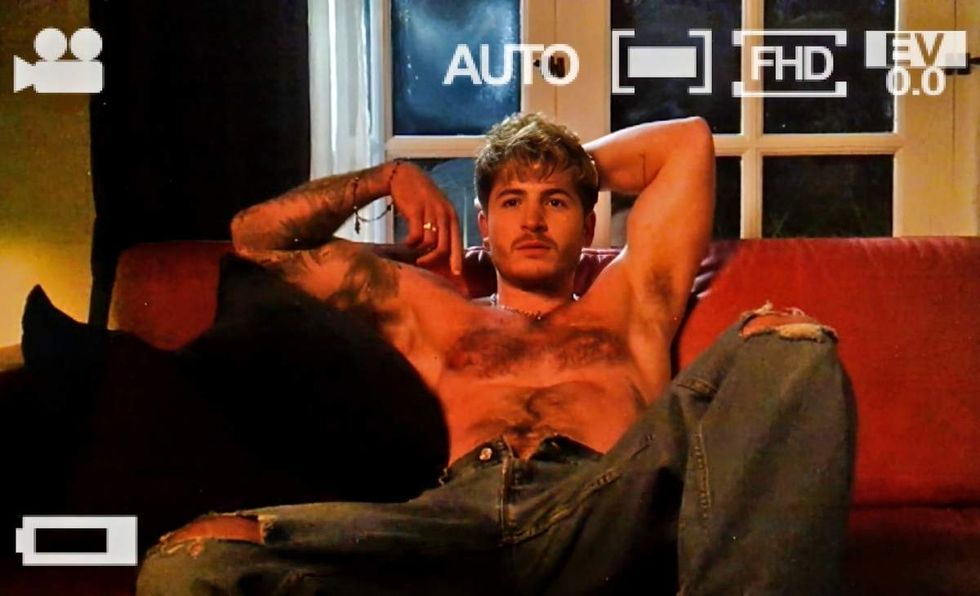 Kieron Moore as Aaron Eagle in Blue Film. Fusion Entertainment
That gap, Tuttle argues, created a striking irony that encapsulated themes in the film like shame, self-loathing, and the stories people tell themselves to survive. "It felt like a fitting outline for all of those things to fit inside," he says of molding Aaron's bravado into a vessel to display a deeper insecurity.
Given the subject matter of Blue Film — a sexually charged reunion between a former student and a former teacher accused of abuse — Tuttle assumed that the role of Hank would be impossible to cast. Instead, Reed Birney, whose performance in Mass (2021) had floored Tuttle at Sundance, became his first choice, which subsequently turned into an official casting.
"Reed is an actor who's really in it for the love of the game," Tuttle says, recalling emails on Thanksgiving full of character questions and psychological conjectures. "I was kind of just over the moon that an actor cared so much, and took it so seriously, because that's what the part really required."
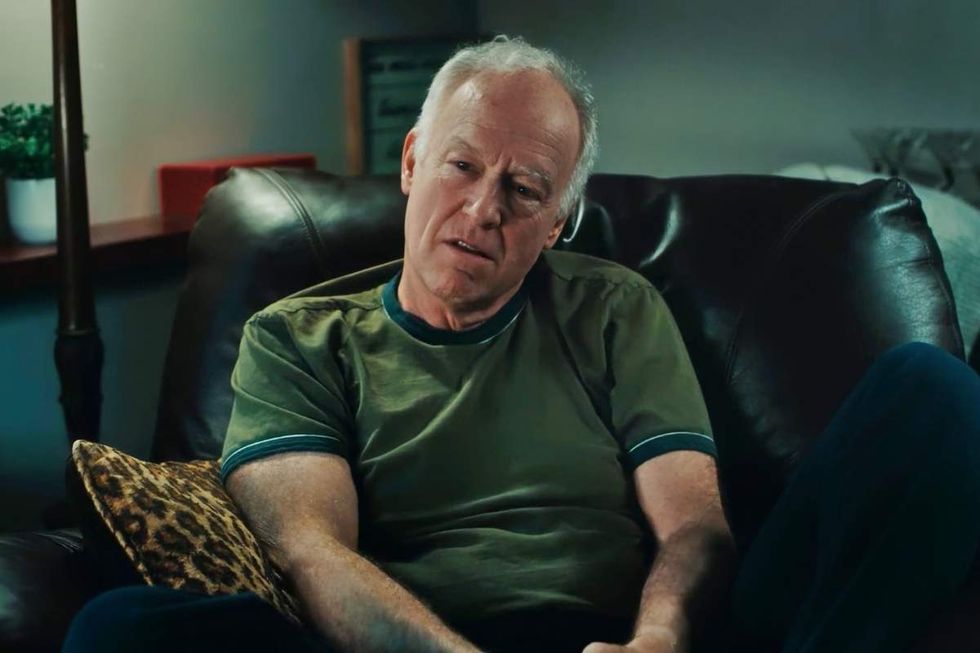 Reed Birney as Hank Grant in Blue Film.Fusion Entertainment
Meanwhile, Kieron Moore came to the project through a Zoom chemistry read with Birney. "Kieron and Reed had an immediate chemistry," Tuttle recalls. "It's so weird to do chem reads over Zoom because you don't see how tall anybody is. But it was immediately there, and it was clear that Kieron had a reverence for Reed, and that Reed was really smitten with Kieron."
Moore proved himself to be intensely invested in the project. Tuttle says, "He was really engaged with the material, and really curious about it. He was asking a lot of questions. He had done his own reading on... He had just read this book on 'pervert psychology.' He was really invested in the themes, and the story of the movie, in a way that you can only hope a young actor would be."
All of that intense preparation did pay off on set while shooting Blue Film. Tuttle reveals that Moore had to deliver roughly 30 pages of monologues and dialogue — in an accent not his own — across the first 30 minutes of the movie, which was entirely shot in a day and a half.
"I kind of just found myself at the monitor, wide-eyed, being like, 'Oh, they're great,'" Tuttle remarks. "If there's one thing that I'm the most proud of in the movie, it's their performances."
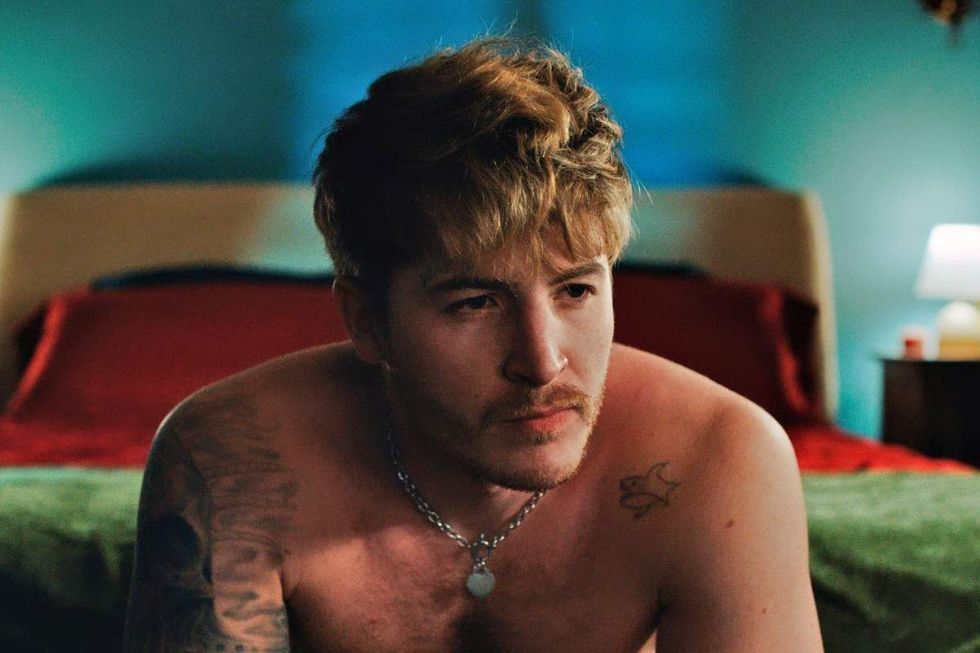 Kieron Moore as Aaron Eagle in Blue Film. Fusion Entertainment
Tuttle thinks of Blue Film as a drama, but acknowledges that he wrote the script like a thriller out of both creative instinct and actual necessity. The production shot in just 12 days on a small budget, with two characters in one location, meaning that it was all too easy to lose the audience altogether. "My job is to keep the narrative engine of the movie going," Tuttle explains. "Any kind of slip in momentum is a potential death for a viewer."
The movie does, in fact, become a moral whodunnit. Viewers are kept on the edge of their seats while renegotiating who these men are to each other, what's true or false in their narratives, and what their endgame for the night might actually be. It is through the unnerving build-up of tension in Blue Film that Tuttle's references jump out the highest, echoing feelings one has while seeing Haneke's Funny Games and The Piano Teacher.
Blue Film enters a landscape of queer films and TV shows that are mostly safer and more crowd-pleasing offerings. However, Tuttle never intended for his debut feature to be evaluated on different terms than other films. "In the movie, our protagonist is gay, and it deals with a lot of queer themes. But, in a lot of ways, it doesn't, to me," Tuttle says, arguing instead that Blue Film is a story about shame, the loss of innocence, and the difficulty of reconciling past and present selves.
And he's right: The strengths of Blue Film are in its capturing of internal reckoning. Tuttle reveals that he was in "kind of a quarter-life crisis" when writing the script — wrestling with grief and feeling disconnected from a more innocent version of himself. In that way, even as the story between Aaron and Hank gets darker, the film is still about the baggage that people carry with themselves when they aren't yet able to forgive themselves for things they still feel guilty about.
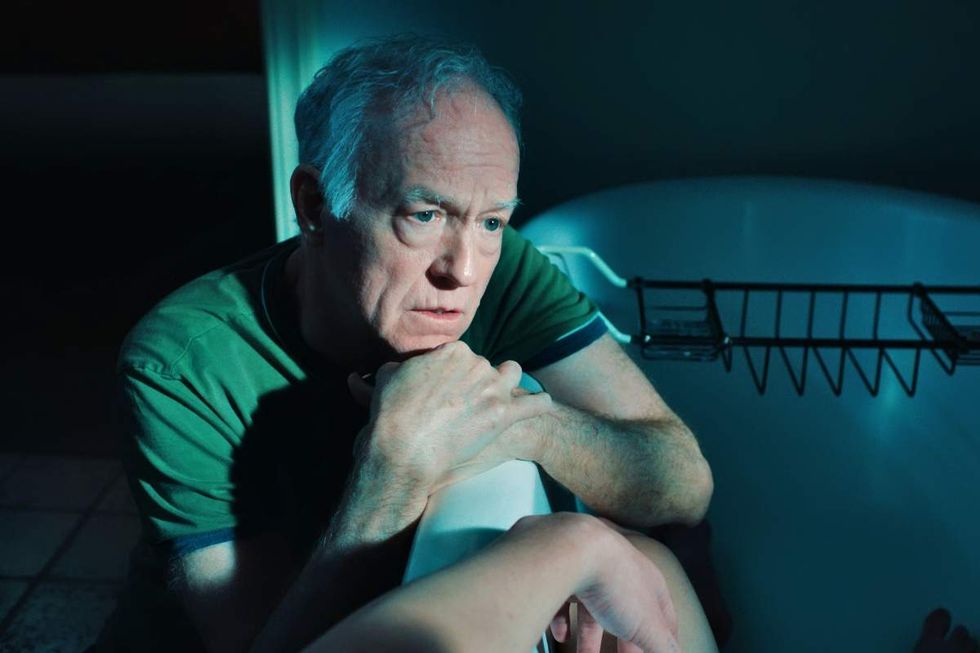 Reed Birney as Hank Grant in Blue Film.Fusion Entertainment
In an industry that seems to be increasingly risk-averse, especially in the U.S., Tuttle knew he was choosing a difficult path for his debut feature. American festivals repeatedly passed on Blue Film, only for Edinburgh to program it and unlock a wave of interest, proving that there's still an appetite for a "subversive kind of cinema" that isn't being entirely met by new work.
On the other hand, Tuttle notes that the shoot itself was "not tortured" as a process, and shares fond memories of how creatively liberated he felt working at such a small scale with supportive collaborators. His dedication to bringing this vision to life was supported by Mark Duplass along the way, who serves as a consulting producer in the project.
"I brought him the script pretty early on in the writing process," Tuttle says, noting that Duplass "has always been very supportive of me, and I consider him a bit of a mentor figure." Across the board, Tuttle sees Duplass's support of young filmmakers as "comprehensive and unwavering."
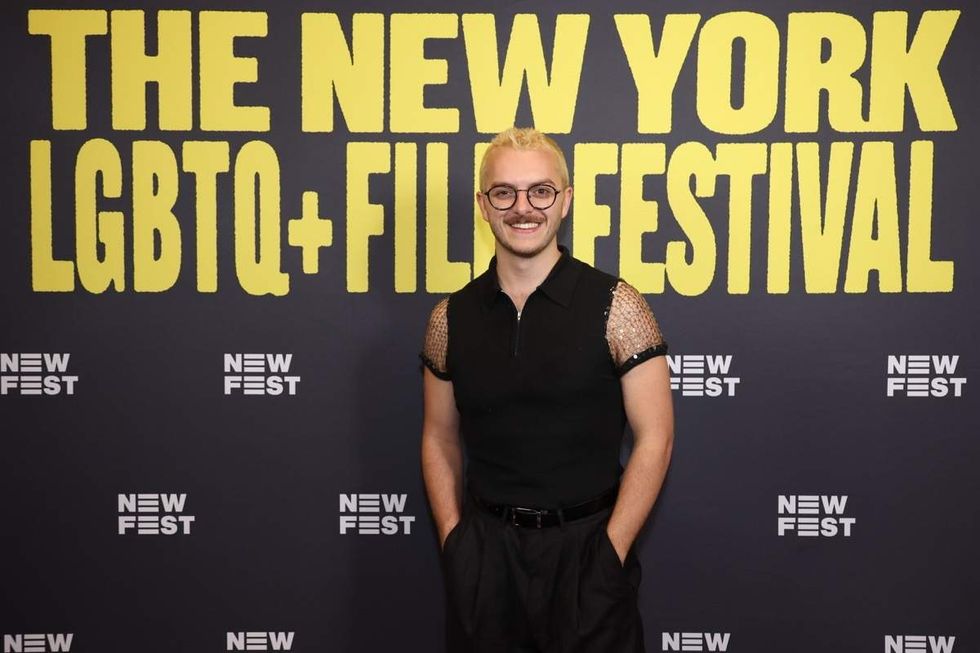 Director Elliot Tuttle at the premiere of Blue Film at 2025 NewFest at SVA Theater in New York City.Rob Kim/Getty Images
Does Tuttle want to keep tackling challenging subjects, like sex, in his next few projects? The filmmaker teases that he "got a lot of that kind of writing out of me with Blue Film." When asked about sky-high dream collaborators, he replies, "It's a very lofty aspiration, but I'd love to work with Isabelle Huppert."
Tuttle is also eager to work with his friend, Ryan Simpkins, in the near future. Otherwise, the writer/director is interested in bringing a musician into their first acting role. "I love the world of music, and I would really love to be able to find something for a musician who's never acted before, and try to build something," Tuttle concludes.
Count us in!
Blue Film is currently playing in film festivals, and a wider release is expected for 2026.
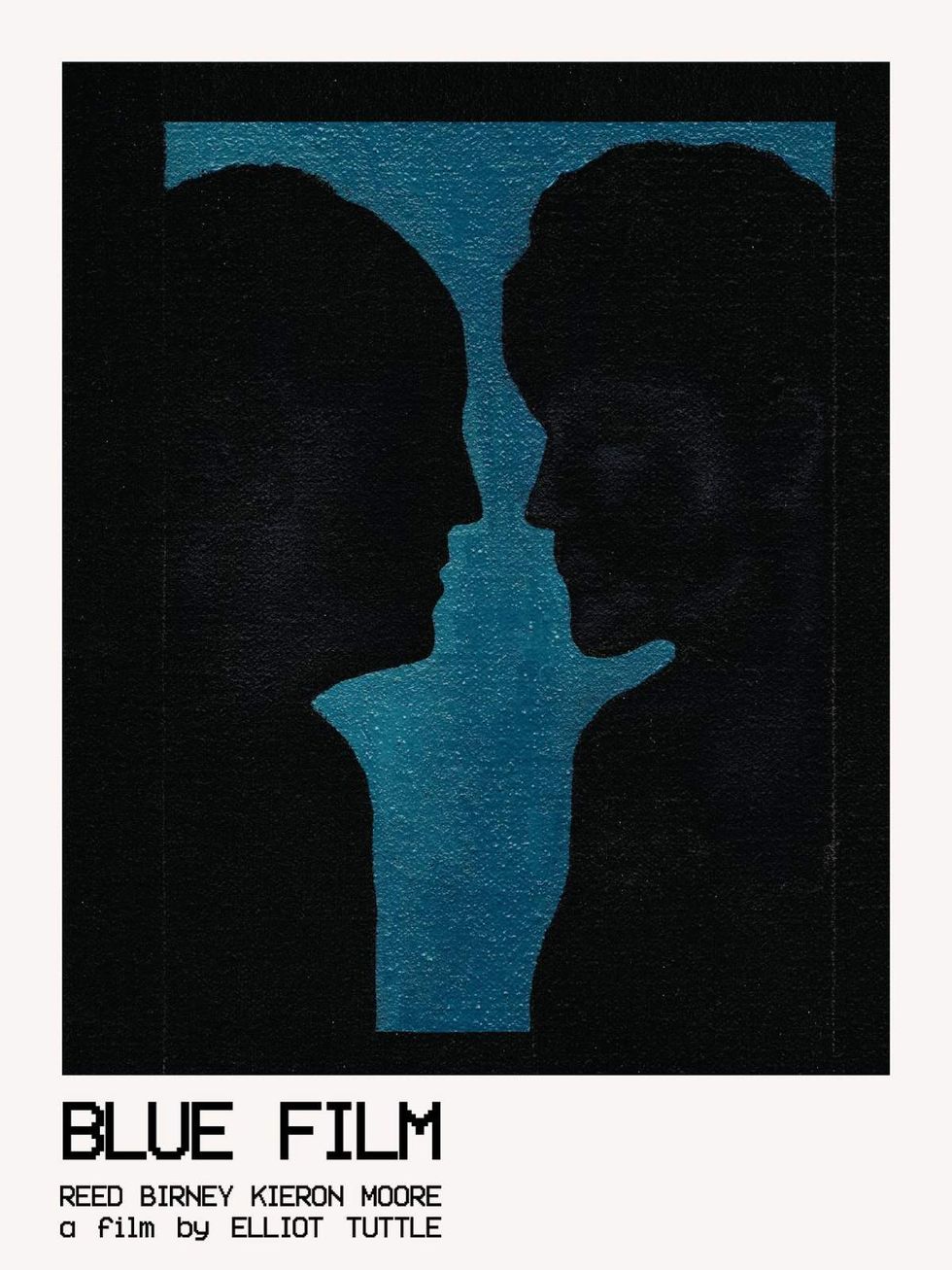 The official poster for Blue Film.