
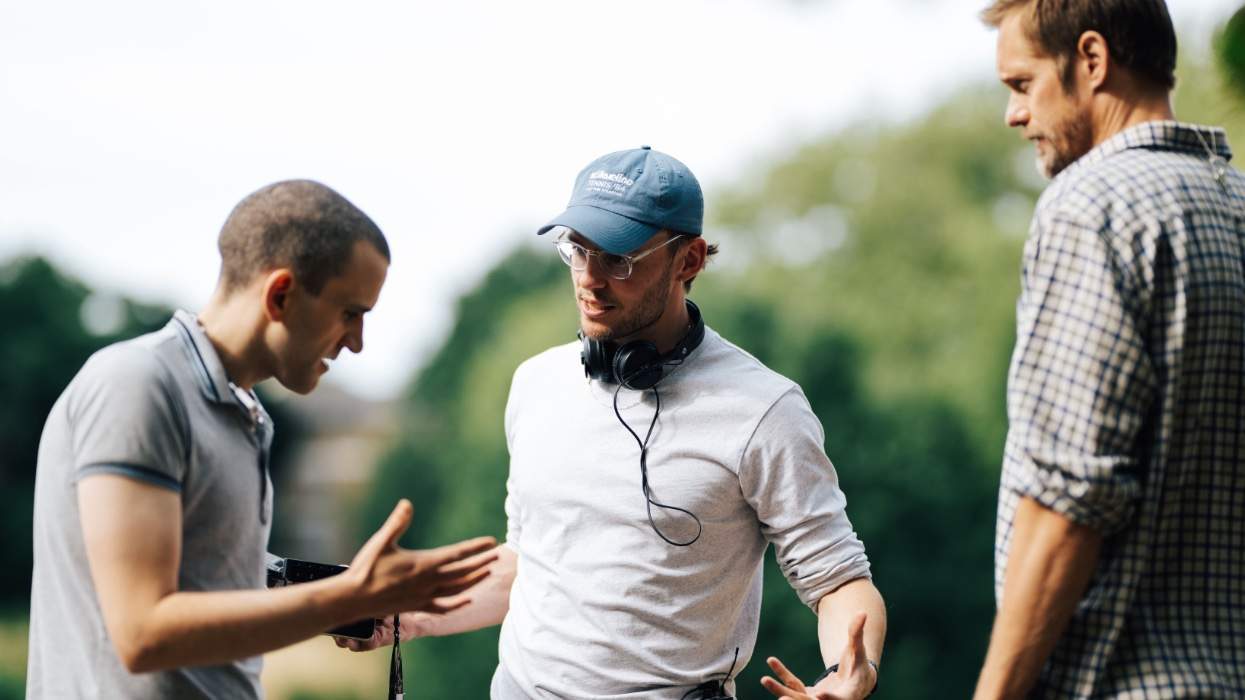






































Pillion has been one of the buzziest films of both 2025 and now 2026, and for good reason. The film marks writer-director Harry Lighton’s feature film debut and stars Alexander Skarsgård alongside Harry Melling as Ray and Colin, two gay men entering into a strict BDSM romance that has captured the imaginations of moviegoers and queer audiences around the world.
It offers a rare glimpse into a world that some know well, and that others have little exposure to, focused on one gay man’s sexual and personal liberation through the lens of submission. It’s steamy, romantic, and heartbreaking — but most of all it’s utterly, unapologetically, queer.
That would be an incredible feat at any time, but in this moment, it feels particularly poignant to see two men exploring love, sex, and domination without apology, without sanitizing it, and with nuance, gentleness, and deep empathy.
Pillion is an astounding achievement and a new benchmark for queer cinema. For months, writer-director Lighton and star Melling have been hitting the media circuit, film festivals, and global premieres. The film finally arrived in U.S. theaters this month, marking what amounts to the end of this journey. PRIDE sat down with Lighton and Melling to talk about how they’re feeling as they approach the end of the line with Pillion, their thoughts on the surrounding discourse, and what ultimately happened to those assless singlets.
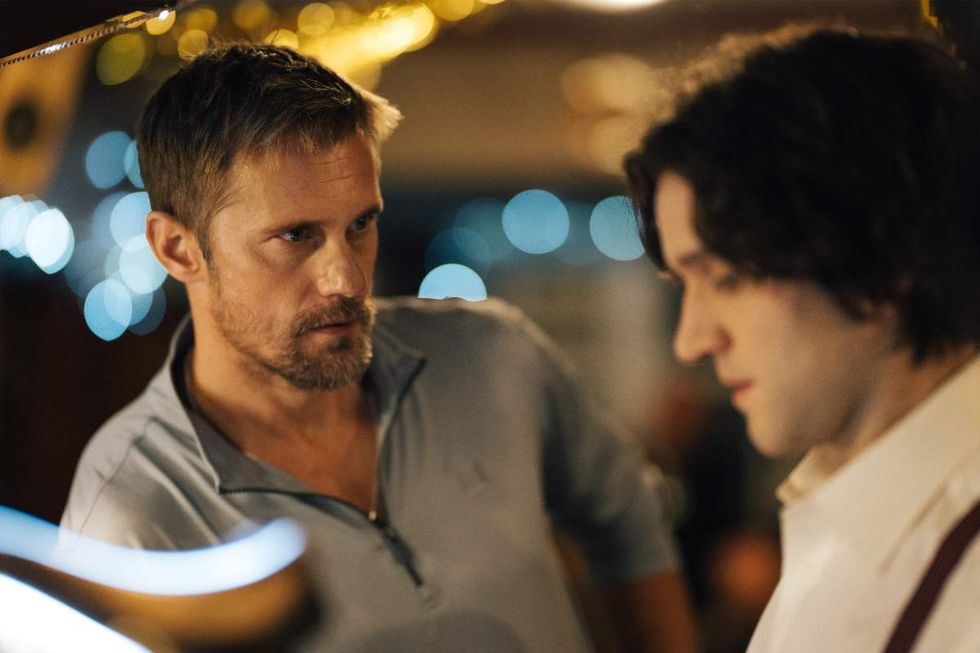
Alexander Skarsgård and Harrry Melling in 'Pillion'
A24
PRIDE: At this point, you’ve been through so many phases with this film, from its inception and filming to festivals and global releases. Where are you each at in terms of your journey with this film?
HARRY LIGHTON: Right now, happy that the work on the film is done because it was a long time, and that it's been received so warmly, generally speaking, in the world.
Everyone who worked on this film—because it was a very low-budget film—did it because they really cared about it. They saw something in the project that made them want to commit a lot of time and effort to something that wasn't going to give them much financial reward. And sharing the making of it, which was very joyful, and then sharing the afterlife of it, which has been full of delightful surprises. It's been an amazing ride. So, I’m just content. Still enjoying it, but starting to get ready to sadly say goodbye and start working on the next thing.
HARRY MELLING: I’m just so happy and thrilled that it's seemingly landing with people, and people can relate to it, and people who wouldn't have much understanding, or wouldn't have been very familiar with this subculture, now are able to really understand and empathize with these characters. So it's just a wonderful thing. But like Harry said, this is the last part of the journey, really. So it's kind of quite sad to say goodbye to it, and to say goodbye to Colin.
Now that you’re at the end of months and months of talking about this film, has there been anything you’ve been waiting for someone to ask about?
HL: The soundtrack choices. The choice of Tiffany to play over the wrestling, because getting the licensing to that track was one of the bigger ordeals of the edit, and one of the more stressful things, where it was like, I'm gonna have to choose a new song, and I really didn't want to choose a new song.
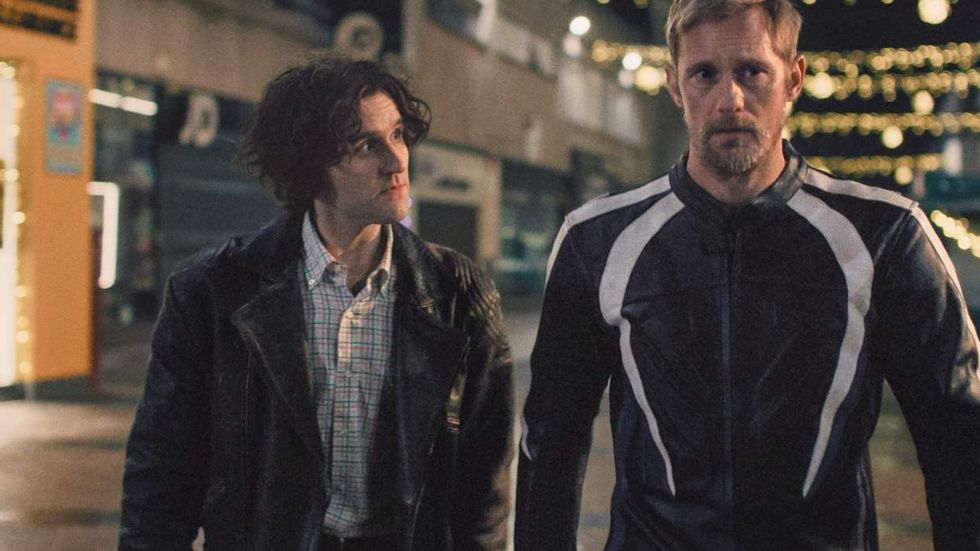
Alexander Skarsgård and Harrry Melling in 'Pillion'
A24
Yeah, talk a little bit about that.
HL: I thought that was a way of [Ray] giving a little, like, crumb of queerness to Colin to play against the brutal machoness of the wrestling. And it nods to the mischief of Tay, that he's able to hold these two kinds of beings in one, like a hyper-masculine embodiment of a sexual fantasy, but then also this, like, mischievous queerness.
But it also—the reason why that song was so necessary to me on a practical level—was the way it ramps up to the chorus was just perfect for when he pulls Colin back into that final surfboard move. And we couldn't find a ramp like that in any other song.
Do you feel like that song follows you now? Do you feel like you hear it everywhere you go?
HL: It's so funny you should say that, because I got on a plane to Glasgow the other day and landed in Glasgow, and it was playing in the taxi. And then, when I went to Finland for New Year’s, it was playing in a Finnish supermarket. And so I do think it's following me around.
One of the things that really struck me about the film is how we see this biker BDSM world through the eyes and perspective of such a gentle soul as Colin. There’s something disruptive about that perspective to the way it's typically depicted. How do you hope that complicates people's understanding of this subculture?
HM: I think it allows an audience in to see it. I think if [Colin] were far more assured as a person, then I think that would really sort of interfere with the audience's gaze, in terms of them in some way being Colin. I’m sure a lot of people coming into this story will not know much about the subculture. There'll, of course, be a lot of people who will, but for those who don't, I think the openness of him, the curiosity of him, is a good canvas in which to see the movie.
HL: The surface of role-playing is often about, like, embodying a certain hardness or softness, depending on your role. But the longer you spend with that person—because no one can kind of live in a role 24/7—then you start to see the underbelly, or the variety to their character. I think maybe something the film's doing is taking two characters who initially seem to exist at poles — one is all hardness and the other is all softness. And then by the end, you have a more complicated understanding of both of those characters, because they've exhibited things which sit in contradiction to that assessment of them.
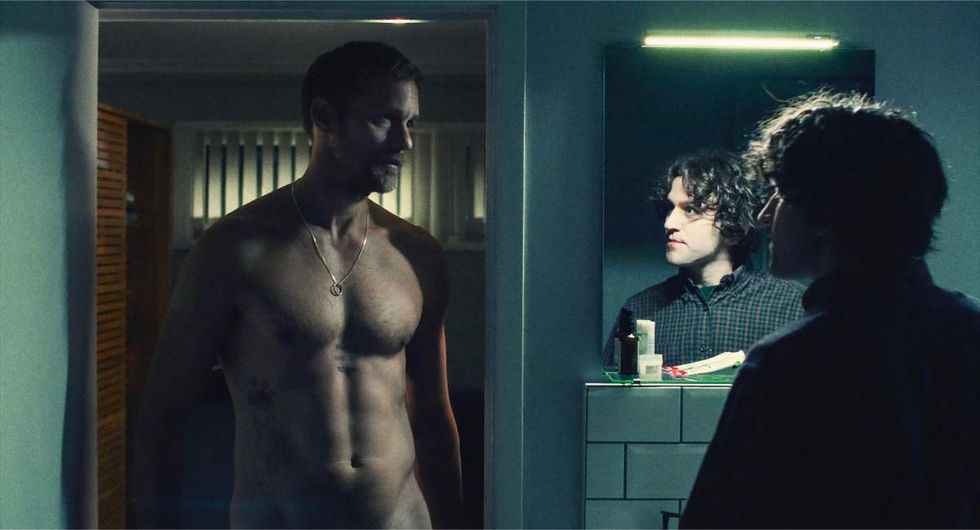
Alexander Skarsgård and Harrry Melling in 'Pillion'
A24
Much has been made of the film’s sex scenes. Did you find that discourse reductive, or were you excited by the kinds of conversations it spurred?
HL: I wouldn't say they are reductive, actually, because if you had to...reduce the film to a log line, then sex is going to be in that log line. It's about a character who’s learning self-definition through sex. And there's more than just sex involved in his relationship with Ray. But ultimately, part of the difference between Ray and Colin is that Colin places emphasis on more stuff besides sex, where Ray kind of keeps it to just sex and domestic submission.
So, sex will always be front and center in discussions about a movie like this. My hope is that, actually, as well as maybe being titillated or disgusted, depending on your persuasion, you'll also be, like, moved, too. Whether that's moved to laughter or tears or compassion, that'll be a lot more of an emotional response to the film than just sort of titillation.
HM: Yeah, exactly. The movie without any of the sex scenes is just kind of unimaginable, really. They're just pivotal in terms of how the movie operates, and the journey that Colin goes on, and equally, the journey that Ray goes on. So if sex stuff is becoming such a topic of conversation, I think it's kind of great, because that is the movie.
I’m just so happy to see a kinky, unapologetic gay movie in the theaters at this moment. Without getting super political, it feels especially poignant when there is a rollback of queer rights. What role do you feel that art, like Pillion, has at a time like this?
HL: I think it can have multiple roles. One role for me that it has is to encourage empathy. There's that quote—I can't remember by whom—that a story can do more than 1,000 facts to teach someone empathy. And I guess my opinion is if someone watches this film, who starts from a point of antipathy towards, let's say, the kink community, or the queer community, and then they sit with this film for 100 minutes. If they don't run out at the first blow job, then they'll end the film with more empathy. Because...these characters become humanized to them, rather than just aliens they want nothing to do with.
That's the role of art for me. There's been times in my life where I've watched something which is which has opened my eyes to a worldview or some sort of experience or identity different from my own, and that's partly what I look for in art, whether it's film or literature or whatever, is finding proximity with people whose experiences I haven't lived.
 Alexander Skarsgård and Harrry Melling in 'Pillion' A24
 Can I ask one last silly question? Did you keep the singlet?
HM: I think the editor might have stolen the singlet? I saw him fashion it at one of the events, and I went, “Where'd you get that?!”
HL: It was like a moving house sale of some of the props. And I think the editor got his hands on the singlet.
That was the hot ticket item. I'm not surprised!
This interview has been lightly edited for length and clarity.




11 times J.K. Rowling did something wildly transphobic, ranked